
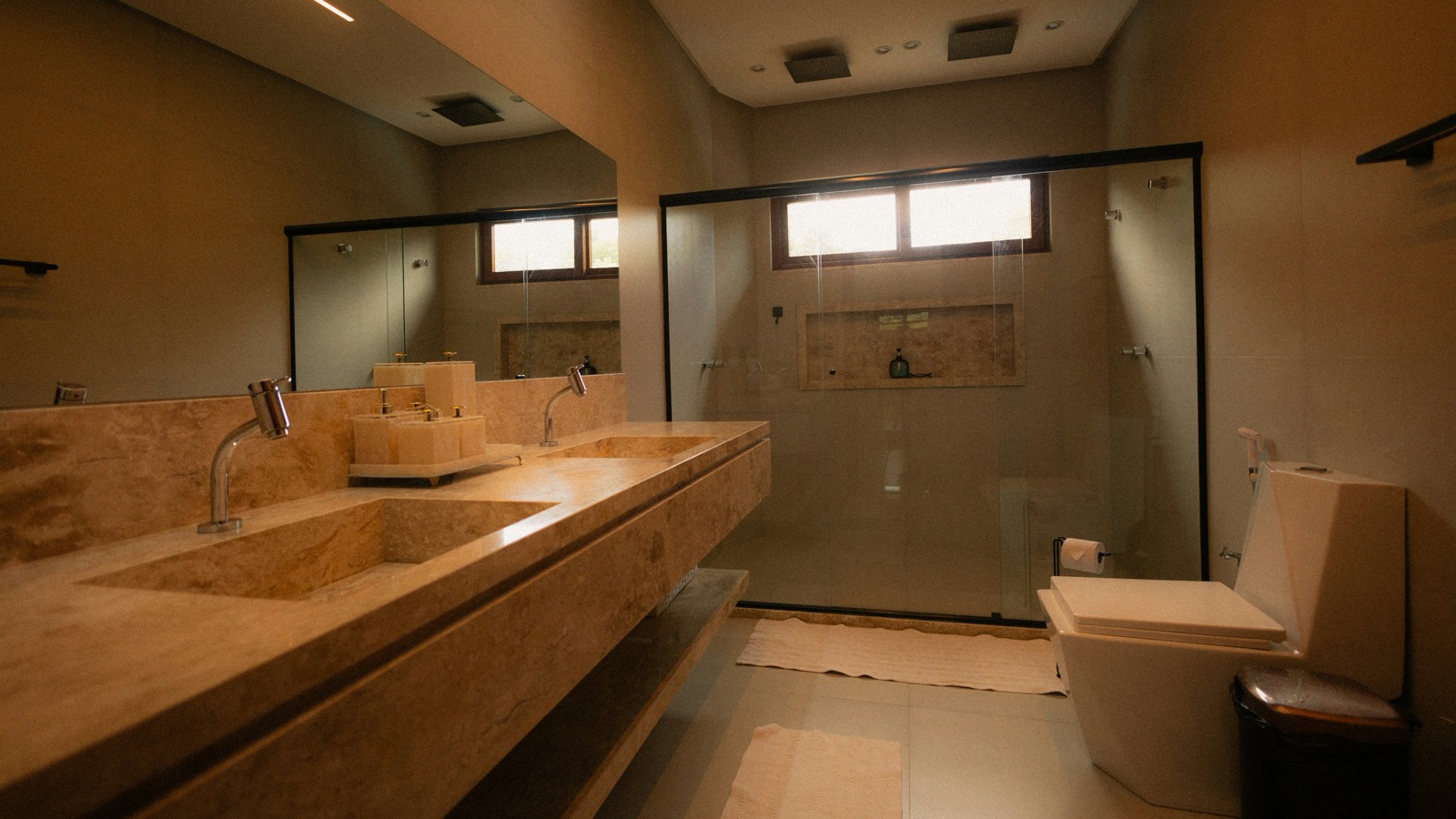
Complete bathroom vanity buying guide for NJ homeowners. Single vs double, floating vs freestanding, material options, sizing by bathroom, and real Monmouth County pricing. Expert advice from Custom Kitchens by Lopez — 20+ years experience.
Plan Your ProjectView Our Work
Custom Kitchens by Lopez TeamApril 7, 202614 min read
Bathroom Vanity Buying Guide: Styles, Materials & NJ Pricing
The bathroom vanity is the anchor of your bathroom design. It is the first thing you see when you walk in, the surface you use every morning and evening, and the primary storage solution for toiletries, towels, and daily essentials. A great vanity makes a bathroom feel designed. A bad vanity makes everything else look worse.
Choosing the right vanity is also one of the most confusing decisions in a bathroom remodel. Single or double? Floating or freestanding? Stock or custom? White oak or painted? Quartz top or marble? Every choice affects function, aesthetics, and budget.
After 20+ years of bathroom remodeling across Monmouth and Ocean Counties, we have installed thousands of vanities — from budget-friendly stock units in powder rooms to custom-built double vanities in luxury master bathrooms. This guide covers everything you need to make a confident vanity decision for your NJ bathroom.
What you will learn:
- Every vanity style and which one fits your bathroom
- Material options for the cabinet and countertop
- Size guide based on your bathroom dimensions
- Real NJ pricing at every budget level
- Installation considerations specific to NJ homes
Need help choosing a vanity? Schedule a free bathroom design consultation or call (732) 984-1043. We will measure your space and recommend the right vanity for your bathroom, style, and budget.
Vanity Styles: Which One Fits Your Bathroom?
Freestanding Vanity (Floor-Mounted)
The traditional vanity style — a cabinet that sits directly on the floor with legs, a toe kick, or a base that rests on the bathroom floor. Available in virtually unlimited sizes, styles, and configurations.
Advantages:
- Maximum storage capacity — full cabinet depth to the floor
- Easier installation (no wall reinforcement needed)
- Wider selection at every price point
- Hides plumbing behind the cabinet
- More forgiving of uneven floors
Disadvantages:
- Harder to clean under and behind
- Can make small bathrooms feel heavier and more enclosed
- Fixed height (standard 32 to 36 inches)
Best for: Guest bathrooms, powder rooms, and any bathroom where storage capacity is the priority. Also the default choice for budget-conscious remodels because stock and semi-custom options are plentiful.
Floating Vanity (Wall-Mounted)
A vanity mounted to the wall with open space between the bottom of the cabinet and the floor. The fastest-growing vanity trend in NJ bathroom design.
Advantages:
- Makes the room feel larger by exposing floor space
- Easy to clean the floor underneath
- Adjustable height — mount at whatever height is comfortable for the users
- Modern, spa-like aesthetic
- Great for small bathroom designs where visual space matters
Disadvantages:
- Requires wall blocking or stud mounting (adds installation cost and complexity)
- Slightly less storage than same-width freestanding vanity
- Plumbing must route through the wall, not the floor (may require plumbing modifications in older NJ homes)
- Not forgiving of wall imperfections — the vanity must sit perfectly flush
Best for: Master bathrooms, modern bathroom designs, and small bathrooms where the visual space gain matters. Floating vanities are standard in our bathroom design trends for 2026 projects.
NJ installation note: Many older Monmouth County homes have plaster-over-lath walls or insufficient stud spacing for floating vanity installation. We always install structural blocking behind the drywall during the demolition phase to ensure the vanity is rock-solid. This is a non-negotiable step that some installers skip — and when they do, the vanity sags within a year.
Furniture-Style Vanity
A vanity designed to look like a piece of furniture — with legs, decorative hardware, and the appearance of a standalone dresser or console table that happens to have a sink. Popular in transitional and traditional bathroom designs.
Advantages:
- Distinctive, high-end appearance
- Exposed legs make the room feel more open (similar to floating vanity)
- Bridges the gap between traditional and modern design
- Available in unique finishes (stained wood, painted with distressed edges, reclaimed materials)
Disadvantages:
- Less storage than enclosed vanities (exposed legs replace cabinet space)
- Plumbing is partially visible beneath the vanity
- Harder to find in standard sizes — often semi-custom or custom
- Cleaning around decorative legs can be tedious
Best for: Powder rooms and guest bathrooms where aesthetics take priority over storage. Also popular in traditional and farmhouse-style bathrooms.
Built-In / Custom Vanity
A vanity designed and built specifically for your bathroom — custom dimensions, custom storage configurations, and materials matched to your exact design vision.
Advantages:
- Fits any space perfectly, including odd dimensions, alcoves, and angled walls
- Maximum storage optimization with internal organizers, drawers, and dividers designed for your specific needs
- Material and finish flexibility — any wood species, paint color, or hardware
- Can integrate features like a makeup station (lower counter height with knee space), built-in laundry hamper, or hidden electrical outlets
Disadvantages:
- Highest cost (4 to 8 weeks lead time)
- Requires a skilled cabinet maker
- Changes or modifications after fabrication are expensive
Best for: Master bathrooms in upscale homes, bathrooms with non-standard dimensions, and any project where a stock or semi-custom vanity does not fit the space or the design vision. See our guide on custom vs stock cabinets for a deeper comparison.
Single vs Double Vanity: The Decision Framework
Choose a Single Vanity When:
- The bathroom is used primarily by one person
- The bathroom is under 60 square feet (a double vanity will crowd the space)
- You prefer more counter space per sink
- Budget is a priority (one sink, one faucet, one drain = lower cost)
- The bathroom is a powder room or guest bathroom
Choose a Double Vanity When:
- Two people use the bathroom simultaneously (couples, shared kids' bathroom)
- The bathroom is 80+ square feet
- You want the master bathroom to feel spacious and complete
- Morning routines overlap and cause bottleneck
- The home will be sold — double vanities are expected in master bathrooms by NJ buyers
The Plumbing Factor
If your existing bathroom has a single sink and you want a double vanity, the plumbing modification adds $500 to $1,500 for a second drain line and water supply. If both sinks can share the same drain wall, costs are lower. If the second sink requires routing across the room, costs increase.
Vanity Size Guide for NJ Bathrooms
Standard Vanity Widths
| Width | Configuration | Best Bathroom Size | Notes |
|---|---|---|---|
| 18-24 in. | Single sink, compact | Powder room, tiny bathroom | Wall-mount or pedestal style often better at this size |
| 30 in. | Single sink, standard | Guest bathroom (40-50 sq ft) | The most common stock vanity size |
| 36 in. | Single sink, generous | Full bathroom (50-70 sq ft) | Good counter space, ample storage |
| 48 in. | Single or double sink | Full to master (70-100 sq ft) | Double sink at 48 inches is tight — prefer single with more counter |
| 60 in. | Double sink, standard | Master bathroom (80-120 sq ft) | The standard double vanity size |
| 72 in. | Double sink, spacious | Large master (100-150 sq ft) | Comfortable spacing between sinks |
| 84+ in. | Double sink, luxury | Large master (150+ sq ft) | Custom territory — impressive presence |
Vanity Depth
Standard vanity depth is 20 to 21 inches. "Shallow" vanities at 18 inches work for tight spaces. "Deep" vanities at 22 to 24 inches accommodate larger sinks and provide more counter space but require more floor clearance.
NJ building code: Minimum 21 inches of clear space in front of the vanity (measured from the front edge to any opposing wall, fixture, or obstruction). In practice, 24 to 30 inches of clearance is comfortable. Under 21 inches fails inspection.
Vanity Height
Standard vanity height is 32 inches (including countertop). "Comfort height" vanities at 36 inches (same as kitchen counter height) are increasingly popular because they reduce bending for most adults.
Our recommendation: 36-inch comfort height for master bathrooms and any vanity used by adults. 32-inch standard height for kids' bathrooms and shared bathrooms used by shorter family members. Floating vanities can be installed at any height — we typically mount them at 34 to 36 inches.
Vanity Cabinet Materials
Solid Wood
Species: White oak, maple, birch, walnut, cherry Durability: Excellent with proper finish Cost: $$ to $$$ Best for: Custom and semi-custom vanities, natural wood looks
Solid wood vanities are the premium choice — beautiful grain, excellent durability, and a quality feel that engineered materials cannot replicate. The key is proper finishing: bathroom humidity and water exposure demand a durable topcoat (conversion varnish or catalyzed lacquer, not just polyurethane).
White oak is the dominant vanity wood in the NJ market in 2026 — its tight grain resists moisture well, and its warm, natural tone works with virtually any bathroom design.
Plywood with Veneer
Durability: Good to excellent Cost: $$ Best for: Painted vanities at mid-range budgets
Most quality semi-custom vanities use furniture-grade plywood with a real wood veneer or a paintable surface. Plywood resists warping and moisture better than solid wood in humid environments, making it an excellent practical choice for bathroom cabinets. This is what most premium vanity brands (James Martin, Restoration Hardware, RTA) use for their cabinet boxes.
MDF (Medium-Density Fiberboard)
Durability: Moderate (vulnerable to moisture if paint seal is compromised) Cost: $ Best for: Painted vanities at budget prices
MDF is smooth, affordable, and takes paint beautifully. The risk: if water penetrates the paint seal (around edges, at hardware holes, or from a leaky faucet), MDF swells and disintegrates. In a bathroom, this is a real risk. We recommend MDF only for painted vanity doors on a plywood cabinet box — never for the full cabinet construction in a bathroom.
Particle Board (Avoid)
Most big-box-store budget vanities use particle board. It is the least moisture-resistant material available and the most common reason vanities fail in NJ bathrooms. Particle board absorbs water like a sponge, swells irreversibly, and crumbles. If your vanity costs under $400 from a home center, it is almost certainly particle board. It will not last in a NJ bathroom.
Vanity Countertop Materials
Quartz (Our Top Recommendation)
Cost: $50-$120 per square foot fabricated and installed Vanity top cost: $500-$2,500 depending on size Maintenance: Zero (no sealing, no staining) Durability: Excellent
Quartz is the default vanity countertop in our Monmouth County bathroom remodels. It resists water, stains, bacteria, and cosmetic products without any maintenance. Available in hundreds of patterns including convincing marble looks. It is the right choice for 80 percent of bathroom vanities. Read our quartz countertop cost guide for detailed NJ pricing.
Natural Marble
Cost: $60-$150 per square foot fabricated and installed Vanity top cost: $600-$3,000 Maintenance: High (seal annually, clean carefully, accept etching) Durability: Moderate (soft, scratches and etches)
Marble is undeniably beautiful on a vanity — the veining and warmth of natural stone create a luxurious surface. The reality: toothpaste, soap, cosmetics, and cleaning products all etch marble over time. If you want marble, commit to the maintenance and accept the patina. Or choose a marble-look quartz and get the aesthetic without the anxiety.
Cultured Marble (Integrated Sink)
Cost: $200-$600 for vanity top with integrated sink Maintenance: Low Durability: Good
Cultured marble is a engineered product — marble dust mixed with resin and cast into a mold that includes the countertop and sink as one seamless piece. No separate sink, no seam, no water infiltration points. It is the budget-friendly choice that looks clean and modern. Available in white, bone, and gray tones. Ideal for guest bathrooms and rental properties.
Granite
Cost: $40-$100 per square foot fabricated and installed Vanity top cost: $400-$2,000 Maintenance: Low (seal every 1-2 years) Durability: Excellent
Granite remains a durable, reliable vanity countertop but has fallen out of fashion in the NJ market. Most homeowners and buyers now prefer quartz or marble-look surfaces. Granite makes sense for budget-conscious projects where durability is the priority and style is secondary.
NJ Pricing at Every Budget Level
Budget: $1,200 - $3,000 (Complete Installation)
- Stock vanity from a quality manufacturer (30-48 inches)
- Cultured marble countertop with integrated sink
- Standard faucet
- Basic installation with existing plumbing
Best for: Guest bathrooms, rental properties, and budget-focused refreshes. This price range delivers a clean, new vanity without custom work.
Mid-Range: $3,000 - $7,000 (Complete Installation)
- Semi-custom vanity (36-60 inches) from a quality brand
- Quartz countertop with undermount sink
- Quality faucet in your preferred finish
- Full installation including minor plumbing adjustments
Best for: Master bathrooms, full bathroom renovations, and homeowners who want quality materials and a cohesive design. This is the sweet spot for most NJ bathroom remodels. See our bathroom remodel cost guide for how vanity costs fit into a full renovation budget.
Premium: $7,000 - $15,000+ (Complete Installation)
- Custom-built vanity in your exact dimensions and design
- Natural stone or premium quartz countertop
- Designer faucet and hardware
- Wall-mount installation with blocking (if floating)
- Custom storage solutions (drawer organizers, pull-outs, integrated lighting)
- Built-in features (makeup station, electrical outlets, soft-close everything)
Best for: Luxury master bathrooms, custom homes, and homeowners who want a vanity that feels like fine furniture. These are the vanities in Holmdel bathroom remodels and similar premium NJ projects.
Installation Considerations for NJ Homes
Older Homes (Pre-1980)
Many Monmouth County homes built before 1980 have bathrooms with plaster walls, cast iron drain pipes, and floor-mounted plumbing. Floating vanity installations in these homes require:
- Removing plaster and installing blocking between studs
- Potentially converting floor-mounted plumbing to wall-mounted
- Verifying wall structure can support the loaded weight
Budget an additional $500 to $1,500 for these modifications.
Plumbing Modifications
| Change | Additional Cost |
|---|---|
| Same location, same configuration | $0-$200 |
| Wider vanity, same drain location | $200-$500 |
| Relocating drain within same wall | $500-$1,000 |
| Adding second sink (double vanity) | $500-$1,500 |
| Moving vanity to opposite wall | $1,500-$3,000 |
| Converting floor drain to wall drain (for floating) | $800-$1,500 |
Electrical
Modern vanity installations often include electrical work: outlets inside drawers (for hair dryers and electric toothbrushes), backlit mirror wiring, under-vanity LED lighting, and heated mirror defogging. Budget $200 to $800 for electrical additions depending on scope.
How to Choose the Right Vanity: Decision Checklist
- Measure your bathroom. Width available for the vanity, depth from wall to walkway, and ceiling height for mirrors and lighting.
- Decide single or double. Based on who uses the bathroom and how.
- Choose freestanding or floating. Based on style preference and whether your walls can support wall-mounting.
- Select cabinet material. Solid wood or plywood for quality. Avoid particle board in bathrooms.
- Choose countertop material. Quartz for most bathrooms. Marble if you accept the maintenance.
- Pick your sink type. Undermount for the cleanest look. Integrated for budget and seamless design. Vessel for a design statement.
- Select hardware and faucet finish. Match or intentionally mix with other bathroom metals.
- Budget for installation. Including plumbing modifications, electrical, and wall reinforcement if floating.
Ready to find the right vanity for your bathroom? Schedule your free in-home bathroom consultation or call us at (732) 984-1043. We will measure your space, discuss options, and recommend the vanity that fits your bathroom, style, and budget. No pressure, no obligation.
Custom Kitchens by Lopez has been remodeling bathrooms across Monmouth and Ocean Counties for over 20 years. From a simple vanity swap in a powder room to a full custom double vanity in a luxury master bath — we have done it all. 46 five-star reviews from homeowners who trust us with their homes.
We serve Freehold Township, Holmdel, Colts Neck, Marlboro, Manalapan, Middletown, Red Bank, Rumson, and all surrounding communities.
*Custom Kitchens By Lopez is a licensed NJ Home Improvement Contractor (HIC #13VH04175700) based in Freehold Township. We specialize in kitchen remodeling, bathroom remodeling, custom cabinetry, and general contracting across Monmouth County and Ocean County, NJ.*
Thinking About a Remodel?
Get expert advice from our team — serving NJ since 2005.
Ready to start your project?
Related Services
Bathroom Remodeling Near MeWalk-In ShowersTile InstallationBathroom Vanities
5 Rating(46+ reviews)
Ready to Transform Your Space?
Our expert designers are ready to help bring your vision to life. Schedule your free consultation today and get a personalized quote for your project.
Request a Design ConsultationCall 732.984.1043
Licensed & Insured20+ Years ExperiencePrivate Consultations
Local Services
Bathroom Remodeling FreeholdMonmouth County Bathroom RemodelingBathroom Remodelers NJ
Popular Service Areas
Holmdel, NJColts Neck, NJRumson, NJMarlboro, NJShrewsbury, NJMiddletown, NJRed Bank, NJFreehold, NJSpring Lake, NJManalapan, NJ
Ready to start your project?
Get a free, no-obligation quote today.
5 (46+ reviews)
Category
Bathroom Design# Freestanding Tubs: Pros, Cons, Cost & Are They Worth It? (NJ 2026)# Shower Niche Ideas, Sizes, Cost & How to Avoid Leaks (NJ 2026)
More Articles
Ready to Start Your Project?
Request a private design consultation for your substantial kitchen, bath, cabinetry, or whole-home project.