
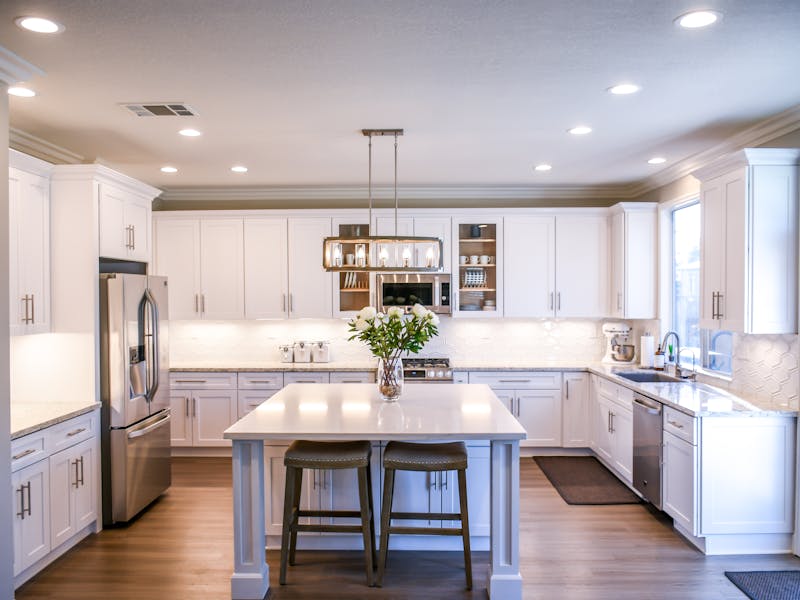
The best kitchen paint colors for 2026 — walls, cabinets, and accents. Warm whites, sage greens, navy blues, and the colors NJ homeowners are actually choosing. Expert color guidance from Custom Kitchens by Lopez.
Plan Your ProjectView Our Work
Custom Kitchens by Lopez TeamApril 7, 202613 min read
Best Kitchen Paint Colors for NJ Homes in 2026
Color is the single most affordable way to transform a kitchen. A $60 gallon of paint changes the entire personality of a room — warmer, cooler, bolder, calmer. And unlike a countertop or cabinet decision, paint can be changed again in a weekend if your taste evolves.
But choosing kitchen paint colors is surprisingly difficult. The lighting in your kitchen, the cabinet finish, the countertop material, the flooring, the sightlines to adjacent rooms — every element influences how a color looks and feels in the space. A color that looks perfect on a paint chip in the store can look completely wrong on your kitchen walls under your specific lighting.
After 20+ years of kitchen remodeling in Monmouth and Ocean Counties, we have seen every color trend come and go. We have watched homeowners agonize over the difference between 47 shades of white. We have seen colors that looked stunning in a magazine look terrible in a north-facing NJ kitchen. Here is what we have learned about choosing kitchen colors that actually work — in your home, in your light, for the long term.
What you will learn:
- The kitchen paint colors dominating NJ homes in 2026
- How NJ's light conditions affect your color choice
- Cabinet colors vs wall colors — the coordination rules
- Which colors have staying power and which will look dated
- Paint finishes, prep, and professional vs DIY
- Real NJ pricing for kitchen painting projects
Planning a kitchen color update? Schedule a free design consultation or call (732) 984-1043. We bring large-format color samples to your home and help you see how colors look in your actual kitchen light — not under fluorescent store lighting.
The Colors Defining NJ Kitchens in 2026
Warm White (The Dominant Force)
White kitchens are not going away — but the shade of white has shifted dramatically. The cool, blue-white tones that defined kitchens from 2015 to 2022 (think Benjamin Moore Chantilly Lace or Decorator's White) have given way to warm whites with creamy, golden, and slightly beige undertones.
The most requested warm whites in our NJ projects:
- Benjamin Moore White Dove (OC-17): The most popular kitchen cabinet color in our 2026 projects. Warm without being yellow, bright without being cold. Works in every NJ light condition.
- Sherwin-Williams Alabaster (SW 7008): A soft, creamy white that feels organic and warm. Particularly beautiful with natural wood accents and brass hardware.
- Benjamin Moore Simply White (OC-117): Slightly brighter and cleaner than White Dove but still warm. Good for kitchens with limited natural light.
- Farrow and Ball Wimborne White (No. 239): A designer favorite with a chalky depth that photograph beautifully. Premium price ($100+ per gallon) but a noticeably richer white.
Why the shift matters: Warm whites create kitchens that feel inviting and comfortable. Cool whites under NJ's winter light (which skews blue-gray from November to March) can make a kitchen feel cold and clinical. Warm whites compensate for that seasonal light shift and feel good year-round.
Where to use warm white: Cabinets (the primary application), walls in small kitchens where you want maximum brightness, open shelving, and trim.
Sage Green (The Breakout Color)
Sage green has gone from a niche design-magazine color to the most requested accent color in NJ kitchens. It works because sage green is essentially a warm neutral — it reads as organic and calming rather than bold or trendy. It pairs naturally with wood tones, warm whites, and stone surfaces. For the full breakdown of green shades, pairings, paint vs. stain, and cost, see our complete guide to green kitchen cabinets.
How NJ homeowners are using sage:
- Island cabinets in sage with warm white perimeter cabinets (the most common application)
- Full sage kitchen in smaller spaces where the color creates a cocooning effect
- Sage backsplash (zellige tiles) with white cabinets — see our backsplash guide
- Sage walls with white cabinets for a soft, enveloping feel
Best sage paint colors:
- Benjamin Moore Saybrook Sage (HC-114): The NJ contractor's go-to sage. Balanced, not too green, not too gray.
- Sherwin-Williams Evergreen Fog (SW 9130): Their 2022 Color of the Year that has become a permanent NJ kitchen staple. More gray-green than pure sage.
- Benjamin Moore October Mist (1495): A softer, more muted sage that works as a full-kitchen color without overwhelming the space.
Navy and Deep Blue (The Sophisticated Accent)
Navy and deep blue remain powerful kitchen accent colors in 2026 — particularly on islands, lower cabinets, and feature walls. Navy adds drama and depth without the heaviness of black. It pairs beautifully with brass hardware, warm white uppers, marble-look countertops, and natural wood flooring.
Best navy paint colors for kitchens:
- Benjamin Moore Hale Navy (HC-154): The definitive kitchen navy. Rich, sophisticated, not too dark.
- Sherwin-Williams Naval (SW 6244): Deep and bold. Their 2020 Color of the Year that remains a NJ kitchen staple.
- Benjamin Moore Gentleman's Gray (2062-20): A softer, slightly grayed navy for homeowners who want depth without maximum contrast.
Where to use navy: Island cabinets (the classic application), lower cabinets in a two-tone design, butler's pantry walls, or accent walls behind open shelving.
Greige and Warm Neutrals (The Safe Bet)
For homeowners who want warmth without committing to a color, greige (gray + beige) is the answer. Greige tones add warmth to walls and cabinets without the design risk of a full color commitment. They work with virtually every countertop material, every flooring choice, and every hardware finish.
Best greige tones:
- Benjamin Moore Revere Pewter (HC-172): The most popular greige in American residential design. Warm, versatile, and a proven seller for resale.
- Sherwin-Williams Accessible Beige (SW 7036): A warm, balanced neutral that works in every light condition. Particularly good for open-concept spaces.
- Benjamin Moore Edgecomb Gray (HC-173): A lighter greige that works as both a wall color and a cabinet color for homeowners who want a warm alternative to white.
Charcoal and Dark Tones (The Bold Choice)
Dark-toned kitchens — charcoal cabinets, deep green-blacks, inky blues — are a growing segment in the high-end NJ market. These are not for everyone, but in the right home with the right light, a dark kitchen creates a dramatic, sophisticated space that feels like a high-end restaurant or a moody European kitchen.
Best dark kitchen colors:
- Benjamin Moore Wrought Iron (2124-10): A chameleon dark that reads as soft black, dark charcoal, or deep green depending on the light. Our most-used dark cabinet color.
- Farrow and Ball Studio Green (No. 93): A deep, rich green-black that feels luxurious. Perfect for the homeowner who wants drama with sophistication.
- Benjamin Moore Midnight Blue (2067-10): Darker than navy, nearly black with blue undertones. Stunning with brass hardware and marble countertops.
Where dark tones work in NJ: Kitchens with abundant natural light (south or west-facing windows), larger kitchens (200+ square feet), homes with high ceilings, and kitchens designed for entertaining. Dark tones in small, north-facing NJ kitchens feel cave-like — test extensively before committing.
How NJ's Light Conditions Affect Your Color Choice
New Jersey's light is not the same as California's light, Florida's light, or even Virginia's light. Our latitude, our seasonal shifts, and our weather patterns all influence how paint colors appear in your kitchen.
North-Facing NJ Kitchens
North-facing kitchens receive cool, indirect light throughout the day. Colors appear bluer and grayer than they look on the paint chip. Warm whites may appear chalky. Sage greens may look gray. Cool grays may feel cold and lifeless.
Recommendation: Go warmer than you think. Choose whites with golden or creamy undertones (White Dove, Alabaster). Choose greens with warm, yellow-green base tones rather than blue-green. Avoid cool grays — they will make a north-facing NJ kitchen feel like a hospital.
South-Facing NJ Kitchens
South-facing kitchens receive warm, abundant light all day. Colors appear warmer and more saturated than on the paint chip. Warm whites may look slightly yellow in midday sun. Bold colors pop more intensely.
Recommendation: You have the most flexibility. Both warm and cool tones work. You can go bolder with color because the natural light will balance it. This is the light condition where dark cabinet colors (charcoal, deep navy) work best.
East-Facing NJ Kitchens
Bright, warm light in the morning that fades to cooler, indirect light in the afternoon. Colors shift throughout the day.
Recommendation: Choose colors that look good in both warm and cool light. Mid-tone warm whites and sage greens handle the transition well. Test your color at both 9 AM and 4 PM before committing.
The NJ Seasonal Factor
From November through March, NJ daylight skews gray-blue. Summer light is warm and golden. Your kitchen color needs to work in both conditions. This seasonal swing is why warm undertones in white and neutral paints are so critical in NJ — they counteract winter's cold light while still looking natural in summer's warm light.
Cabinet Color vs Wall Color: The Coordination Rules
Rule 1: Cabinets Set the Tone, Walls Support
Your cabinet color is the dominant visual element in the kitchen. It covers the most surface area at eye level and defines the room's personality. The wall color plays a supporting role — it fills the spaces above, below, and between cabinets and should complement rather than compete.
Rule 2: Different Undertones, Same Temperature
Cabinets and walls should share the same color temperature (warm or cool) even if they are different colors. Warm white cabinets with warm gray walls: cohesive. Warm white cabinets with cool blue-gray walls: dissonant. Sage green cabinets with warm cream walls: cohesive. Sage green cabinets with cool white walls: jarring.
Rule 3: Contrast Creates Definition
If your cabinets and walls are too close in color, the kitchen looks flat and undefined. You need enough contrast between the two to create visual separation. White cabinets need walls that are at least 2 to 3 shades different — a soft greige, a pale sage, or a warm gray. If cabinets and walls are the same white, the kitchen looks like the inside of an unfinished box.
Rule 4: Open Concept Demands Continuity
In an open-concept kitchen, the kitchen wall color flows into the living and dining areas. Choose a wall color that works across all three spaces — not a color that makes sense in the kitchen but clashes with the living room. Warm neutrals (Revere Pewter, Accessible Beige, Edgecomb Gray) are the safest choice for open-concept NJ homes.
Common Pairings That Work
| Cabinet Color | Wall Color | Style |
|---|---|---|
| Warm white (White Dove) | Soft greige (Revere Pewter) | Classic, timeless |
| Warm white (Alabaster) | Pale sage (October Mist) | Organic, fresh |
| Sage green (Saybrook Sage) | Warm white (Simply White) | Modern, layered |
| Navy (Hale Navy) on island | Warm white (White Dove) everywhere else | Sophisticated contrast |
| Natural wood cabinets | Warm white or soft cream walls | Scandinavian, warm modern |
| Charcoal (Wrought Iron) | Same charcoal or warm white | Dramatic, enveloping |
Paint Finishes for Every Kitchen Surface
Cabinets: Semi-Gloss or Satin
Cabinets take the most abuse in a kitchen — grease, steam, fingerprints, food splatters, and constant cleaning. They need a durable, washable finish.
Semi-gloss is the traditional choice: maximum durability, easy to wipe clean, and a visible sheen that highlights the cabinet profile. The downside is that semi-gloss shows every imperfection in the surface — dents, brush strokes, and uneven surfaces are magnified.
Satin has become the more popular choice in 2026: still durable and cleanable, but with a softer, more sophisticated sheen. Satin is more forgiving of surface imperfections and gives a more contemporary appearance.
Critical note: Kitchen cabinets should be professionally sprayed — not brushed or rolled. Spray application delivers a smooth, factory-quality finish without brush marks or roller texture. This is the difference between cabinets that look professionally finished and cabinets that look DIY.
Walls: Eggshell or Satin
Kitchen walls need a finish that can be wiped clean without showing every wall imperfection.
Eggshell is the sweet spot: slight sheen for cleanability, enough flatness to hide minor wall imperfections, and a soft appearance that looks good in all lighting conditions.
Satin is better for areas immediately adjacent to the stove and sink where grease and moisture are concentrated.
Ceiling: Flat
Flat or matte finish on kitchen ceilings. The ceiling is not a surface that gets touched or splashed, and flat finish hides the imperfections that every ceiling has. Flat white ceilings also make rooms feel taller.
Trim and Molding: Semi-Gloss
Trim, crown molding, baseboards, and window casings in semi-gloss — it highlights the profile detail, is extremely durable and cleanable, and creates a subtle contrast with the eggshell walls.
NJ Pricing for Kitchen Painting (As of 2026)
| Project Scope | DIY Cost | Professional Cost |
|---|---|---|
| Kitchen walls only (average kitchen) | $100-$300 | $800-$2,000 |
| Kitchen walls + trim | $150-$400 | $1,200-$2,500 |
| Kitchen cabinets (professional spray) | Not recommended | $3,000-$8,000 |
| Full kitchen (walls + cabinets + trim + ceiling) | Not recommended | $4,000-$10,000 |
| Accent wall or feature color | $50-$100 | $300-$600 |
DIY vs Professional
DIY walls: Reasonable for a confident painter. Prep is everything — clean, patch, prime, tape, and use quality paint (Benjamin Moore Regal Select or Sherwin-Williams Emerald).
Professional walls: Worth it if you want perfect results, do not want to spend a weekend painting, or have high ceilings, complex trim, or open-concept layouts where cut-in quality matters.
DIY cabinets: Do not do this. Cabinet painting requires proper cleaning and degreasing, bonding primer application, multiple coats of sprayed finish paint, and curing time between coats. DIY cabinet painting is the most common kitchen DIY regret in our experience — peeling, chipping, and brush-marked cabinets within the first year.
Professional cabinets: Essential. Professional cabinet painters remove doors and hardware, spray in a controlled environment, and apply 2 to 3 coats of catalyzed or acrylic alkyd paint that bonds permanently and resists kitchen abuse.
Colors to Avoid in 2026
All-Gray Everything
The gray kitchen trend peaked around 2018 to 2020. Gray cabinets, gray countertops, gray backsplash, gray walls — it was everywhere. Today, all-gray kitchens look cold, dated, and lifeless. Gray is still fine as an accent or undertone (greige walls, gray countertop veining), but a monochromatic gray kitchen screams 2018.
Stark Cool White
Cool whites (those with blue or gray undertones) make NJ kitchens feel cold, especially in winter. The design world has moved decisively toward warm whites, and cool white kitchens already look like the previous era of design.
Builder-Grade Beige
The yellowy beige tones that dominated new construction from 1995 to 2010 are firmly dated. If your kitchen walls are a flat, warm beige with no sophistication, an update to greige or warm white is one of the fastest improvements you can make.
Trend-Specific Saturated Colors on All Cabinets
Emerald green, cobalt blue, or terracotta on every cabinet in the kitchen is a bold bet on a specific trend. These colors work beautifully as accents — an emerald island, a cobalt pantry door — but committing your entire kitchen to a saturated trend color means committing to that trend. Use bold color strategically, not everywhere.
The Timeless Strategy: Build a Foundation That Lasts
The smartest approach to kitchen color — and the one we recommend for NJ homeowners who want their kitchen to feel current for 10+ years — is a warm neutral foundation with personality added through changeable elements.
The foundation (expensive to change): Cabinets in warm white, soft cream, or natural wood tone. Countertops in white or warm-veined quartz or quartzite. Flooring in warm wood or neutral porcelain.
The personality (affordable to change): Wall paint, backsplash tile, pendant lights, cabinet hardware, bar stools, window treatments, and accessories. These are the elements where you express the current trend without risking the permanent investments.
This approach lets you follow color trends without a renovation. When sage green fades and the next color takes over, you repaint the walls and swap the accessories — not the cabinets.
Need help choosing your kitchen colors? Schedule a free design consultation or call (732) 984-1043. We bring large-format color samples, test them against your cabinets and countertops, and help you see the final result before you commit to a single gallon of paint.
Custom Kitchens by Lopez has been designing and building kitchens across Monmouth and Ocean Counties for over 20 years. We know which colors work in NJ light, which trends have staying power, and how to create a kitchen that feels current without chasing every fad. Verified reviews from homeowners who trust us with their homes.
We serve Freehold Township, Holmdel, Colts Neck, Marlboro, Manalapan, Middletown, Red Bank, Rumson, and all surrounding communities.
*Custom Kitchens By Lopez is a licensed NJ Home Improvement Contractor (HIC #13VH04175700) based in Freehold Township. We specialize in kitchen remodeling, bathroom remodeling, custom cabinetry, and general contracting across Monmouth County and Ocean County, NJ.*
Planning a Complete Kitchen?
See how CKL plans custom cabinetry, premium materials, and $75,000+ kitchen projects.
Ready to start your project?
Related Services
Kitchen Remodeling Near MeCustom Kitchen CabinetsCountertop InstallationKitchen Backsplash Installation
5 Rating(46+ reviews)
Ready to Plan the Complete Kitchen?
Move from product research to a complete design plan. See real CKL kitchens, the decisions that define luxury work, and the $75,000–$150,000+ planning range.
Explore Luxury KitchensCall 732.984.1043
Licensed & Insured20+ Years ExperienceLuxury kitchens from $75,000
Local Services
Kitchen Remodeling FreeholdKitchen Remodeling EdisonKitchen Cabinets FreeholdKitchen Cabinets EdisonMonmouth County Kitchen Remodeling
Popular Service Areas
Holmdel, NJColts Neck, NJRumson, NJMarlboro, NJShrewsbury, NJMiddletown, NJRed Bank, NJFreehold, NJSpring Lake, NJManalapan, NJ
Ready to start your project?
Get a free, no-obligation quote today.
5 (46+ reviews)
Category
Kitchen Design# Coffee Bar Ideas: Designs + What It Costs to Build One (NJ 2026)# Green Kitchen Cabinets: The Complete Guide to Shades, Pairings, Paint & Cost
More Articles
Ready to Start Your Project?
Request a private design consultation for your substantial kitchen, bath, cabinetry, or whole-home project.