
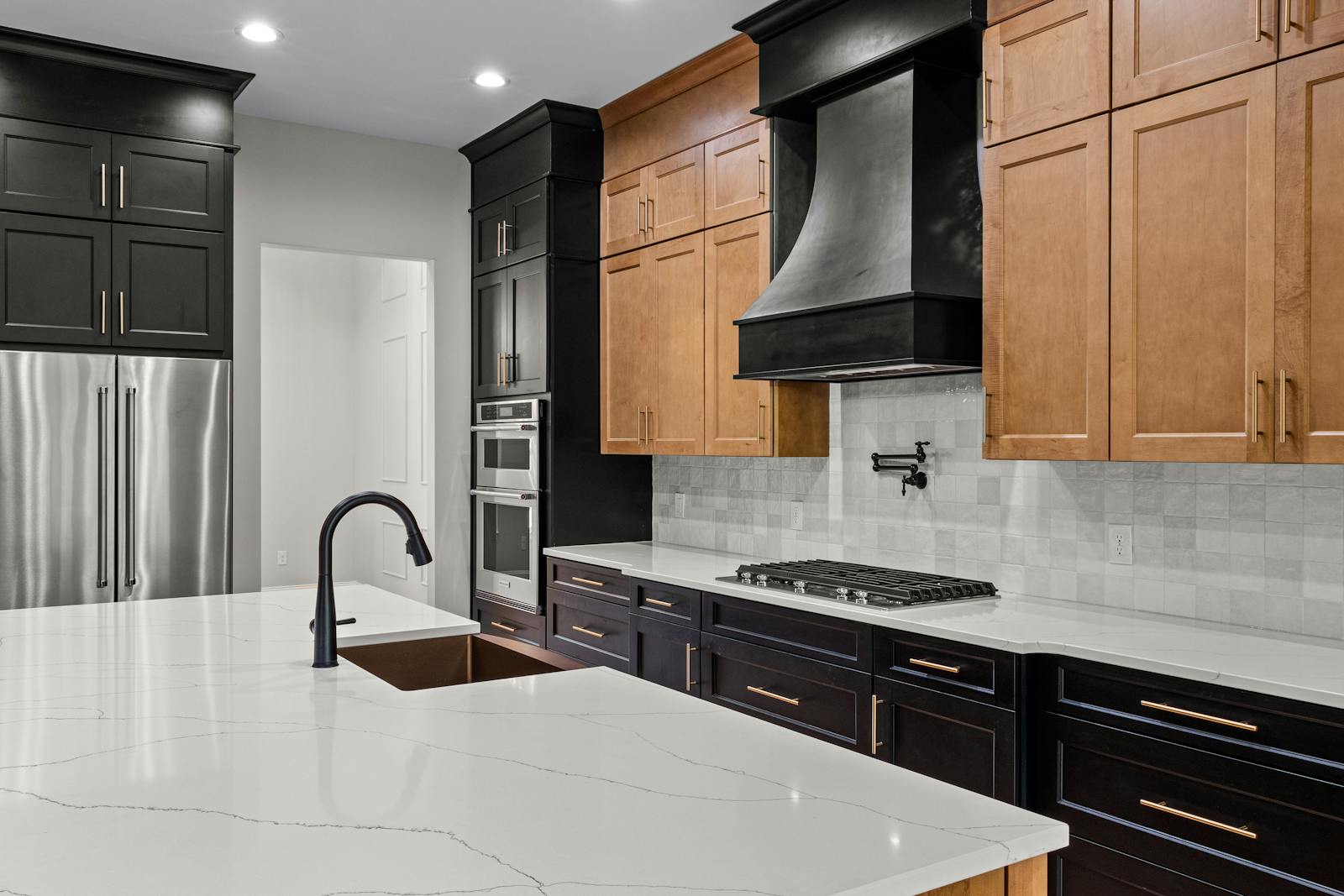
Every kitchen sink type explained for NJ homeowners. Undermount, farmhouse, drop-in, integrated, and workstation sinks. Stainless steel, granite composite, fireclay, cast iron, and copper materials. Sizes, installation methods, costs, and what works best in NJ kitchens. Expert guidance from Custom Kitchens by Lopez.
Plan Your ProjectView Our Work
Custom Kitchens by Lopez TeamApril 7, 202624 min read
Kitchen Sink Types & Styles: The Complete NJ Buyer's Guide
Your kitchen sink is the hardest-working fixture in your home. It is used more than any faucet, appliance, or surface — 30 to 50 times per day in an average household. Washing dishes, rinsing produce, filling pots, soaking baking sheets, washing hands, bathing the baby — the sink handles all of it.
Despite this, most NJ homeowners spend less time choosing their kitchen sink than choosing their backsplash tile. That is a mistake. The wrong sink frustrates you every single day. The right sink makes every kitchen task easier, keeps your countertops cleaner, and becomes something you genuinely appreciate long after the novelty of new cabinets and countertops fades.
At Custom Kitchens by Lopez, we have installed thousands of kitchen sinks in New Jersey homes since 2005 — every type, every material, every configuration on this list. This guide covers every kitchen sink option available with honest NJ pricing, practical pros and cons, and guidance on what works best in real NJ kitchens.
What this guide covers:
- Every kitchen sink type (undermount, farmhouse, drop-in, integrated, workstation)
- Every common sink material with pros, cons, and NJ pricing
- Size guide by cabinet width
- Installation methods and countertop compatibility
- Single bowl vs. double bowl decision guide
- Best sink types for different kitchen styles
Kitchen Sink Types by Installation Method
How a sink mounts to the countertop is the first decision. Each installation method has a different look, different countertop requirements, and different maintenance profile.
Undermount Sinks
The sink bowl is mounted beneath the countertop, with the countertop edge overhanging the sink rim. No lip or edge is visible above the counter surface.
Appearance: Clean, seamless transition from countertop to sink. The countertop edge is exposed, showcasing the material. Countertop compatibility: Granite, quartz, marble, quartzite, concrete, solid surface. NOT compatible with laminate or tile. NJ cost (installation only): $200 to $400
Pros:
- Cleanest look — no raised rim collecting crumbs and grime
- Easy to wipe spills and crumbs directly from the counter into the sink
- Showcases the countertop material edge
- Most popular choice for modern, transitional, and contemporary NJ kitchens
Cons:
- Requires solid-surface countertop (adds cost if upgrading from laminate)
- The countertop-to-sink junction must be perfectly sealed — any gap allows water intrusion that can damage the cabinet below
- Slightly more complex installation than drop-in
Our recommendation: Undermount is the default for any NJ kitchen remodel with stone or quartz countertops. The clean look and easy maintenance make it the most practical long-term choice.
Drop-In (Top-Mount) Sinks
The sink has a visible rim or flange that sits on top of the countertop surface. The sink drops into a cutout from above.
Appearance: Visible rim around the sink edge. The rim sits on the countertop surface. Countertop compatibility: All materials including laminate, tile, butcher block, and solid surface. NJ cost (installation only): $100 to $250
Pros:
- Compatible with every countertop material, including laminate
- Simplest installation — the rim supports the sink weight on the counter surface
- Easier to replace (the old sink lifts out, the new one drops in)
- DIY-friendly installation
Cons:
- The raised rim collects food debris, soap residue, and water — requires regular cleaning around the rim
- Interrupts the clean countertop line (less seamless than undermount)
- Looks less refined in modern and transitional kitchens
When it makes sense: Drop-in sinks are the right choice when you are keeping laminate countertops, replacing a sink without replacing countertops, or working within a tight budget. They are also appropriate for secondary prep sinks and laundry room sinks where aesthetics are secondary to function.
Farmhouse (Apron-Front) Sinks
The front face of the sink extends beyond the edge of the cabinet, exposing the apron — a large, flat or slightly curved front panel that becomes a visual feature.
Appearance: The exposed front face is the defining visual element. Available in flat (modern) or slightly curved (traditional) profiles. The depth and width of farmhouse sinks make them visually substantial. Countertop compatibility: Granite, quartz, marble, quartzite, concrete, solid surface. NJ cost (sink only): $600 to $2,500 depending on material NJ cost (installation): $300 to $600 (requires custom cabinet modification)
Pros:
- Dramatic visual presence — the exposed apron is a design statement
- Typically wider and deeper than standard sinks (33 to 36 inches wide, 9 to 10 inches deep)
- Accommodates large pots, baking sheets, and bulky items easily
- Timeless style that works in farmhouse, transitional, and modern kitchens
Cons:
- The base cabinet must be modified or custom-built to support the sink (farmhouse sinks are heavy — fireclay models weigh 80 to 150 pounds)
- The exposed front face can chip if struck by heavy objects (fireclay and cast iron models)
- Standing close to the sink means leaning slightly over the exposed apron, which can be uncomfortable for shorter users
- Installation is more complex and expensive than undermount or drop-in
Material options for farmhouse sinks:
- Fireclay — The classic choice. White, cream, or occasionally colored. Extremely durable. Resists staining and scratching. NJ cost: $800 to $2,000.
- Cast iron with porcelain enamel — Traditional material, heavy (100 to 150 pounds), available in dozens of colors. Kohler Whitehaven is the most popular model in NJ. NJ cost: $600 to $1,500.
- Stainless steel — Modern farmhouse aesthetic. Lighter weight, less traditional appearance. NJ cost: $400 to $1,200.
- Copper — Artisan, rustic aesthetic. Develops a living patina over time. NJ cost: $800 to $2,500.
- Granite composite — Durable, affordable, available in multiple colors. NJ cost: $500 to $1,200.
Integrated (Seamless) Sinks
The sink bowl is fabricated as part of the countertop material, creating a completely seamless, joint-free surface from counter to basin.
Appearance: No visible border between the countertop and the sink. The surface flows continuously into the bowl. Materials that support integration: Solid surface (Corian), stainless steel (welded), concrete (poured), natural stone (carved from the slab — extremely expensive). NJ cost: $1,500 to $5,000+ (depends on material and complexity)
Pros:
- The cleanest possible installation — zero joints, zero seams, zero places for grime to accumulate
- Unique, custom appearance
- Easy to clean — one continuous wipe from counter to bowl
Cons:
- If the sink or countertop is damaged, both may need replacement (they are one piece)
- Limited material options
- Significantly more expensive than separate sink + countertop
- Not available in all countertop materials (no quartz, no granite unless custom-carved)
Workstation Sinks
An oversized undermount or drop-in sink with built-in interior ledges that support custom-fit accessories: cutting boards, colanders, drying racks, roll-up grids, and prep bowls.
Appearance: Wide, deep, with visible interior ledges (typically 1 to 2 inches below the sink rim) running the length of the bowl. NJ cost (sink + accessory kit): $400 to $1,500 NJ cost (installation): $200 to $400
Pros:
- Combines the function of a sink, cutting board, colander, drying rack, and prep station in one fixture
- All prep and cleanup happens over the drain — less counter mess
- Accessories slide to any position along the ledges
- Available in single and double configurations
- The fastest-growing sink category in 2026
Cons:
- Requires a wider cabinet (typically 33 or 36 inches) to accommodate the oversized bowl
- The accessories add cost ($100 to $400 for a full set)
- Some cheaper workstation sinks have poorly designed ledges where accessories do not slide smoothly
- The accessories need to be washed and stored when not in use
Our recommendation: If you have the cabinet width, a workstation sink is the most functional sink you can install in a 2026 NJ kitchen. Brands to consider: Kraus (best value), Ruvati (solid mid-range), and Kohler Prolific (premium).
Kitchen Sink Materials
Material determines how the sink looks, how it handles daily use, how long it lasts, and how much maintenance it requires.
Stainless Steel
The most popular kitchen sink material worldwide. An alloy of steel, chromium, and nickel that resists corrosion and staining.
NJ cost: $150 to $800 (sink only) Gauge matters: Stainless steel sinks are measured by gauge — lower numbers mean thicker steel. 16-gauge (thickest residential option) is 0.0625 inches; 18-gauge is 0.050 inches; 20-gauge is 0.0375 inches. We recommend 16 or 18-gauge for NJ kitchens. 20-gauge dents easily and sounds hollow when water hits it. Finish options: Brushed (most popular, hides scratches), polished (mirror-like, shows scratches), satin (between brushed and polished).
Pros:
- Most affordable sink material
- Virtually indestructible — does not crack, chip, or break
- Lightweight (easy to install)
- Heat resistant (you can place a hot pot directly in it)
- Available in every size, configuration, and installation method
- Recyclable
Cons:
- Scratches easily (brushed finish minimizes visibility of scratches)
- Shows water spots on polished finishes
- Noisy (water hitting steel creates sound) — quality sinks have sound-dampening pads
- Can develop water spots in NJ's hard-water areas if not dried regularly
Best stainless steel brands for NJ: Kraus (excellent value), Elkay (commercial-grade quality), Kohler (reliable residential standard), Blanco (German engineering).
Granite Composite
A mixture of 80 percent crushed granite stone and 20 percent acrylic resin, molded into a sink shape. The result is a dense, heavy, stone-like sink.
NJ cost: $300 to $900 (sink only) Color options: Black, white, gray, brown, and occasionally blue or green. The color runs through the entire material — scratches do not reveal a different color underneath.
Pros:
- Extremely scratch resistant (harder than stainless steel)
- Heat resistant up to 530 degrees F
- Stain resistant (non-porous surface)
- Quieter than stainless steel (the dense material absorbs sound)
- Available in colors that match or contrast with countertops
- Does not show water spots
Cons:
- Heavier than stainless steel (requires sturdier mounting)
- Can chip if struck by a heavy object at the edge (though less likely than fireclay)
- Light-colored granite composite can develop dark stains over time if acidic substances (lemon juice, tomato sauce) are left sitting for extended periods
- Cannot be repaired if cracked (must be replaced)
Best granite composite brands for NJ: Blanco Silgranit (industry leader), Kraus Forteza, Elkay Quartz Classic.
Fireclay
A type of ceramic clay fired at extremely high temperatures (1,800 to 2,100 degrees F), creating a dense, glass-like surface. The traditional material for farmhouse sinks.
NJ cost: $600 to $2,000 (sink only) Color options: Primarily white and off-white. Some manufacturers offer colors (navy, black, gray), but white dominates the market.
Pros:
- Beautiful, classic appearance with a smooth, glossy finish
- Extremely durable — resists staining, scratching, and chemical damage
- Easy to clean (the non-porous surface repels stains)
- Color is baked in at high temperature — does not fade or yellow over decades
- The gold standard for farmhouse-style sinks
Cons:
- Heavy (80 to 150 pounds depending on size) — requires reinforced cabinet support
- Can chip if struck hard by a cast iron pan or heavy ceramic dish (the chip reveals raw clay underneath)
- Limited color options compared to other materials
- More expensive than stainless or composite
Best fireclay brands for NJ: Rohl Shaws (premium English-made), Bocchi (Italian, excellent value), Kohler Whitehaven (widely available).
Cast Iron with Porcelain Enamel
Cast iron molded into a sink shape and coated with a thick layer of porcelain enamel in any color.
NJ cost: $300 to $1,200 (sink only) Color options: Dozens — white, black, navy, gray, red, teal, and more. Kohler offers 30+ enamel colors.
Pros:
- The widest color range of any sink material
- Porcelain surface is smooth, glossy, and easy to clean
- Extremely durable (cast iron base lasts indefinitely)
- Retains heat (useful for soaking dishes in hot water)
- Available in undermount, drop-in, and farmhouse styles
Cons:
- Very heavy (70 to 120 pounds) — requires reinforced cabinet support
- Porcelain enamel can chip if struck by heavy objects, exposing the cast iron underneath
- Exposed cast iron will rust if the chip is not repaired promptly
- The enamel surface can scratch over time from abrasive cleaners
Maintenance tip for NJ: Keep a bottle of touch-up enamel paint (available from the sink manufacturer) under the kitchen sink. Repair any chips immediately to prevent rust formation. In NJ's humid climate, exposed cast iron rusts faster than in dry climates.
Copper
Solid copper sheets formed into a sink bowl. Develops a living patina (natural color change from bright copper to darker brown and green tones) over time.
NJ cost: $500 to $2,500 (sink only)
Pros:
- Stunning, artisan appearance
- Naturally antimicrobial (copper kills bacteria on contact)
- Each sink develops a unique patina based on use — no two copper sinks look the same after a year
- Extremely long-lasting (50+ years)
Cons:
- The patina changes constantly — some homeowners find this frustrating
- Acidic foods (lemon juice, tomato sauce, vinegar) create visible marks on the patina
- Requires specific care — no abrasive cleaners, no bleach, no harsh chemicals
- The most expensive common sink material
- Patina may develop unevenly in NJ's humid climate
Best for: Rustic, farmhouse, Mediterranean, and artisan-style NJ kitchens where the sink is a showpiece and the homeowner appreciates the living-material character.
Single Bowl vs. Double Bowl: The Decision
This is the most debated question in kitchen sink selection. The answer depends on how you actually use your kitchen.
Choose Single Bowl If:
- You regularly wash large pots, sheet pans, and baking sheets (they do not fit in a divided double bowl)
- You have a dishwasher and rarely hand-wash full dish loads
- You want maximum flexibility in sink use
- You prefer a cleaner, more modern aesthetic
- Your base cabinet is 30 inches wide (a single bowl maximizes the usable space in a small cabinet)
Choose Double Bowl If:
- You frequently hand-wash dishes (one side for washing, one for rinsing)
- You want to soak items in one side while using the other for active tasks
- You prefer a traditional kitchen aesthetic
- You do significant food prep that benefits from a separate clean-water basin
Choose 60/40 Split If:
- You want the flexibility of two bowls but need one large enough for big items
- The 60 side handles pots and sheet pans; the 40 side handles rinsing, soaking, or garbage disposal
Choose a Low-Divide Double Bowl If:
- You want two separate drain zones but need the ability to fit large items across both sides
- The divider rises only 2 to 3 inches from the sink floor, creating two zones while allowing a sheet pan to lay flat across the full width
Kitchen Sink Sizes: What Fits Your Cabinet
| Cabinet Width | Maximum Sink Width | Common Sink Sizes | Best For |
|---|---|---|---|
| 24 inches | 21-22 inches | 21" single bowl | Small kitchens, prep sinks |
| 27 inches | 24-25 inches | 24" single bowl | Compact kitchens |
| 30 inches | 27-28 inches | 28" single bowl, 28" double bowl | Standard NJ kitchens |
| 33 inches | 30-31 inches | 30" single bowl, 30" workstation, 33" farmhouse | Most popular NJ size |
| 36 inches | 33-34 inches | 33" single bowl, 33" workstation, 36" farmhouse | Large NJ kitchens |
Depth guide:
- 8 inches — Standard depth. Comfortable for most users. Less splashing.
- 9 inches — Popular mid-range. Good balance of capacity and comfort.
- 10 inches — Deep bowl. Fits large stockpots easily. Requires more bending.
- 12 inches — Extra deep. Commercial-style capacity. Can cause back strain for shorter users.
NJ-specific consideration: NJ has older homes with non-standard cabinet sizes. Before ordering a sink, measure the interior width of the sink cabinet (not the face frame width), the depth from front to back, and check for obstructions (plumbing, garbage disposal, water filter systems). A sink that doesn't fit the cabinet is the most frustrating (and avoidable) installation problem.
Best Kitchen Sinks by Kitchen Style
| Kitchen Style | Best Sink Type | Best Material | Recommended |
|---|---|---|---|
| Modern | Undermount single bowl | Stainless steel (16ga) | Kraus Standart PRO 32" |
| Transitional | Undermount single bowl | Granite composite | Blanco Silgranit 33" |
| Farmhouse | Apron-front | Fireclay | Bocchi Contempo 33" |
| Traditional | Undermount double bowl | Cast iron | Kohler Deerfield 33" |
| Coastal | Farmhouse apron | Fireclay (white) | Rohl Shaws 33" |
| Industrial | Undermount workstation | Stainless steel | Ruvati Roma 33" |
| Rustic | Farmhouse apron | Copper | Sinkology Adams 33" |
Installation Best Practices
Undermount Installation Tips
- The countertop fabricator handles the cutout and sink mounting — not the plumber. Coordinate delivery of the sink to the fabricator before countertop templating.
- Provide the exact sink model with the manufacturer's cutout template. A mismatched cutout is irreversible.
- Specify the reveal: zero reveal (countertop edge flush with the sink rim — cleanest look, hardest to fabricate), positive reveal (countertop overhangs the sink by 1/8 to 1/4 inch — most common, easiest to clean), or negative reveal (sink rim visible above the countertop — unusual, used for visual effect).
Farmhouse Sink Installation Tips
- The sink cabinet must be a dedicated farmhouse sink base with an open front (no center stile or face frame across the opening). Standard sink bases do not work.
- Fireclay and cast iron farmhouse sinks require a reinforced cabinet bottom — plywood, not particleboard — rated for the sink's filled weight (200+ pounds for a large fireclay sink filled with water and dishes).
- The countertop is templated and fabricated after the sink is installed. The stone meets the sink at the back and sides, with the front apron exposed.
Workstation Sink Installation Tips
- Verify that the accessory ledge height works with your countertop thickness. Standard countertop thickness is 1.25 inches (3cm). If the ledges sit too low after installation, accessories won't sit flush with the counter surface.
- Order the full accessory kit at the time of sink purchase. Third-party accessories rarely fit precisely on manufacturer-specific ledges.
Common Kitchen Sink Mistakes
Mistake 1: Choosing a sink that doesn't fit your biggest pot or sheet pan. Before purchasing, measure your largest frequently-used item. A half-sheet baking pan (18 x 13 inches) needs at least a 27-inch-wide, 16-inch-front-to-back single-bowl sink to lay flat.
Mistake 2: Buying a 20-gauge stainless steel sink. The thin steel dents when a heavy pot drops, sounds hollow when water runs, and flexes when you lean against it. 16 or 18-gauge is the minimum for a quality NJ kitchen sink.
Mistake 3: Forgetting about the garbage disposal. If you are installing or plan to install a garbage disposal, the sink drain must be compatible (3.5-inch standard drain opening) and the cabinet must have space for the disposal unit below the bowl. Deep workstation sinks can conflict with under-sink disposal space.
Mistake 4: Ignoring faucet hole count. Undermount and farmhouse sinks typically have no faucet holes — the faucet mounts through the countertop. Drop-in sinks usually have 1, 2, 3, or 4 pre-drilled holes. Make sure the sink's hole count matches your faucet and accessory setup (faucet + soap dispenser + sprayer + hot water dispenser = 4 holes).
Mistake 5: Not matching sink finish to other fixtures. Your sink, faucet, and cabinet hardware should be in the same finish family. A polished chrome faucet on a brushed stainless sink is a subtle mismatch that professionals notice immediately.
Ready to Choose Your Kitchen Sink?
The right kitchen sink makes daily life measurably easier. We help NJ homeowners select the sink type, material, and size that matches their cooking habits, kitchen design, and budget — and we install it as part of a complete kitchen remodel or as a standalone upgrade.
Call us at (732) 984-1043 or request a free consultation to discuss your kitchen sink project.
Related Guides
- Kitchen Faucet Buying Guide
- Kitchen Countertop Materials Guide
- Kitchen Remodeling Cost Guide
- Kitchen Island Ideas: 15 Stunning Designs
- Kitchen Remodeling Services
*Custom Kitchens by Lopez is a licensed NJ Home Improvement Contractor (HIC #13VH04175700) serving Monmouth County and Ocean County since 2005.*
Planning a Complete Kitchen?
See how CKL plans custom cabinetry, premium materials, and $75,000+ kitchen projects.
Ready to start your project?
Related Services
Countertop InstallationCustom Kitchen CabinetsTile InstallationHardwood Flooring
5 Rating(46+ reviews)
Ready to Plan the Complete Kitchen?
Move from product research to a complete design plan. See real CKL kitchens, the decisions that define luxury work, and the $75,000–$150,000+ planning range.
Explore Luxury KitchensCall 732.984.1043
Licensed & Insured20+ Years ExperienceLuxury kitchens from $75,000
Local Services
Kitchen Cabinets FreeholdKitchen Cabinets EdisonKitchen Cabinets ManalapanKitchen Cabinets MarlboroKitchen Remodeling FreeholdBathroom Remodeling Freehold
Popular Service Areas
Holmdel, NJColts Neck, NJRumson, NJMarlboro, NJShrewsbury, NJMiddletown, NJRed Bank, NJFreehold, NJSpring Lake, NJManalapan, NJ
Ready to start your project?
Get a free, no-obligation quote today.
5 (46+ reviews)
Category
Materials Guide# Porcelain Countertops: Pros, Cons, Cost & Vs. Quartz (2026 NJ Guide)# Soapstone Countertops: Pros, Cons, Cost & Colors (2026 NJ Guide)
More Articles
Ready to Start Your Project?
Request a private design consultation for your substantial kitchen, bath, cabinetry, or whole-home project.