
Porcelain vs ceramic tile — which is right for your NJ kitchen or bathroom? Compare durability, water absorption, cost, and installation. Expert advice from 20+ years of Monmouth County remodeling.
Plan Your ProjectView Our Work
Custom Kitchens by Lopez TeamApril 7, 202614 min read
Porcelain vs Ceramic Tile for NJ Kitchens & Bathrooms: Complete Guide
Walk into any tile showroom in Monmouth County and you will see hundreds of options that all look remarkably similar. Porcelain and ceramic tiles sit side by side on the same display walls, often in identical sizes, colors, and patterns. The price tags are different. The labels are different. But to your eye, they look the same.
They are not the same. And for New Jersey homeowners — where humid summers, cold winters, and high home values create specific demands — choosing the right tile type is a decision that affects your kitchen or bathroom for the next 15 to 25 years.
After 20+ years of kitchen remodeling and bathroom remodeling across Monmouth and Ocean Counties, we have installed millions of square feet of both porcelain and ceramic tile. We know where each one excels, where each one falls short, and exactly which one you should choose for every room in your NJ home.
What you will learn:
- The real differences between porcelain and ceramic tile (not the marketing version)
- Which type performs better in NJ kitchens, bathrooms, mudrooms, and laundry rooms
- Honest cost comparisons for the New Jersey market
- Installation differences that affect long-term performance
- How to avoid the most common tile selection mistakes
Need help choosing tile for your remodel? Schedule a free consultation or call (732) 984-1043. We will help you pick the right tile for your space, budget, and lifestyle.
What Actually Makes Porcelain and Ceramic Different
Both porcelain and ceramic are made from clay, shaped, glazed, and fired in a kiln. That is where the similarities end. The differences in raw materials, manufacturing temperature, and density create two fundamentally different products.
Ceramic Tile
Ceramic tile is made from a mixture of red or white clay, sand, and water. The clay is pressed into shape, coated with a glaze (the colored surface you see), and fired in a kiln at 1,800 to 2,000 degrees Fahrenheit.
The result is a lighter, softer tile with a porous body beneath the glazed surface. The glaze provides the color, pattern, and surface protection. The clay body underneath is a different color — usually reddish or tan — and absorbs water more readily.
Water absorption rate: 3% to 7% Hardness (Mohs scale): 5 to 6 Break strength: Moderate Best for: Walls, backsplashes, light-traffic floors, decorative applications
Porcelain Tile
Porcelain tile is made from a finer, denser clay (often feldspar-enriched) mixed with minerals and fired at significantly higher temperatures — 2,200 to 2,500 degrees Fahrenheit. This extreme heat vitrifies the clay, essentially turning it into a glass-like solid.
The result is a denser, harder tile with consistent color throughout its full thickness. If you chip a porcelain tile, the color continues all the way through. The body itself resists water penetration, not just the glaze.
Water absorption rate: Less than 0.5% Hardness (Mohs scale): 7 to 8 Break strength: High Best for: Floors, wet areas, high-traffic zones, outdoor applications, radiant heat systems
Head-to-Head Comparison: Every Factor That Matters
Water Absorption and Moisture Resistance
This is the single most important difference for NJ homeowners, and it is not close.
| Factor | Ceramic | Porcelain |
|---|---|---|
| Water absorption rate | 3-7% | Less than 0.5% |
| Shower floor safe | Risky | Excellent |
| Shower wall safe | Acceptable with proper waterproofing | Excellent |
| Humid bathroom safe | Adequate for walls | Excellent everywhere |
| Freeze-thaw resistant | Poor to moderate | Excellent |
| Coastal NJ recommended | Walls only | Floors and walls |
Why this matters in New Jersey: NJ summers are humid. Bathrooms in older Monmouth County homes often have limited ventilation. And if you have an enclosed porch, mudroom, or three-season room, the tile is exposed to temperature extremes. Porcelain's near-zero absorption rate means moisture does not penetrate the tile body — period. Ceramic relies entirely on its glaze and grout seal to keep water out, and both of those degrade over time.
For shower floors specifically, porcelain is the only responsible choice. Water sits on your shower floor constantly. Ceramic shower floor tiles absorb moisture into the body over years, eventually leading to mold behind the tile, grout failure, and tile delamination. We have torn out dozens of ceramic shower floors in Monmouth County that failed in 7 to 10 years because of this issue.
Durability and Hardness
| Factor | Ceramic | Porcelain |
|---|---|---|
| Mohs hardness | 5-6 | 7-8 |
| Scratch resistance | Moderate | High |
| Chip resistance | Moderate | High |
| Impact resistance | Lower | Higher |
| Wear rating (PEI) | 1-3 (light to moderate traffic) | 3-5 (moderate to heavy traffic) |
| Expected lifespan | 10-20 years | 20-30+ years |
Porcelain is harder, denser, and more resistant to wear. In a kitchen where chairs scrape across the floor, pots get dropped, and foot traffic is constant, porcelain maintains its appearance significantly longer than ceramic. The hardness difference is measurable — porcelain rates 7 to 8 on the Mohs scale (the same hardness scale used for gemstones), compared to ceramic's 5 to 6.
This difference is less important on walls and backsplashes, where the tile is not subjected to foot traffic, impact, or abrasion. For backsplash applications, ceramic performs perfectly well and the durability gap is largely irrelevant.
Cost Comparison (NJ Market Pricing)
| Cost Component | Ceramic | Porcelain |
|---|---|---|
| Material cost per sq ft | $2-$8 | $5-$15 |
| Installation per sq ft | $6-$12 | $7-$15 |
| Total installed per sq ft | $8-$20 | $12-$30 |
| Kitchen floor (150 sq ft) | $1,200-$3,000 | $1,800-$4,500 |
| Bathroom floor (50 sq ft) | $400-$1,000 | $600-$1,500 |
| Shower walls (60 sq ft) | $480-$1,200 | $720-$1,800 |
| Backsplash (30 sq ft) | $240-$600 | $360-$900 |
NJ-specific pricing note: Labor rates in Monmouth and Ocean Counties run 10 to 15 percent above the national average. Skilled tile setters in the NJ market charge $7 to $15 per square foot for installation, with the higher end for large-format tiles, complex patterns, and premium substrates. These rates apply equally to ceramic and porcelain installation.
Porcelain installation costs slightly more per square foot because the tile is harder to cut, requires diamond-blade wet saws, and demands a higher-quality thinset mortar for proper adhesion. A standard ceramic installation crew can cut tiles with a manual snap cutter. Porcelain requires powered cutting tools on every cut.
The lifetime cost argument: Porcelain costs 20 to 40 percent more upfront than comparable ceramic. But porcelain lasts 20 to 30 years or more, while ceramic in high-traffic or wet areas typically needs replacement at 10 to 15 years. Over a 25-year period, one porcelain installation is cheaper than two ceramic installations — and you avoid the disruption and cost of a mid-life replacement.
Appearance and Design Options
Both porcelain and ceramic are available in virtually unlimited colors, patterns, sizes, and finishes in 2026. Modern manufacturing technology has eliminated most visual differences between the two.
Where ceramic has an edge:
- Handmade and artisan tiles (zellige, encaustic, hand-painted) are almost always ceramic
- More variety in small-format decorative tiles
- Unique textures and surface irregularities that add character
Where porcelain has an edge:
- Wood-look tiles (porcelain produces more realistic wood grain textures)
- Large-format tiles (24x48, 48x48 panels) — porcelain handles large formats better structurally
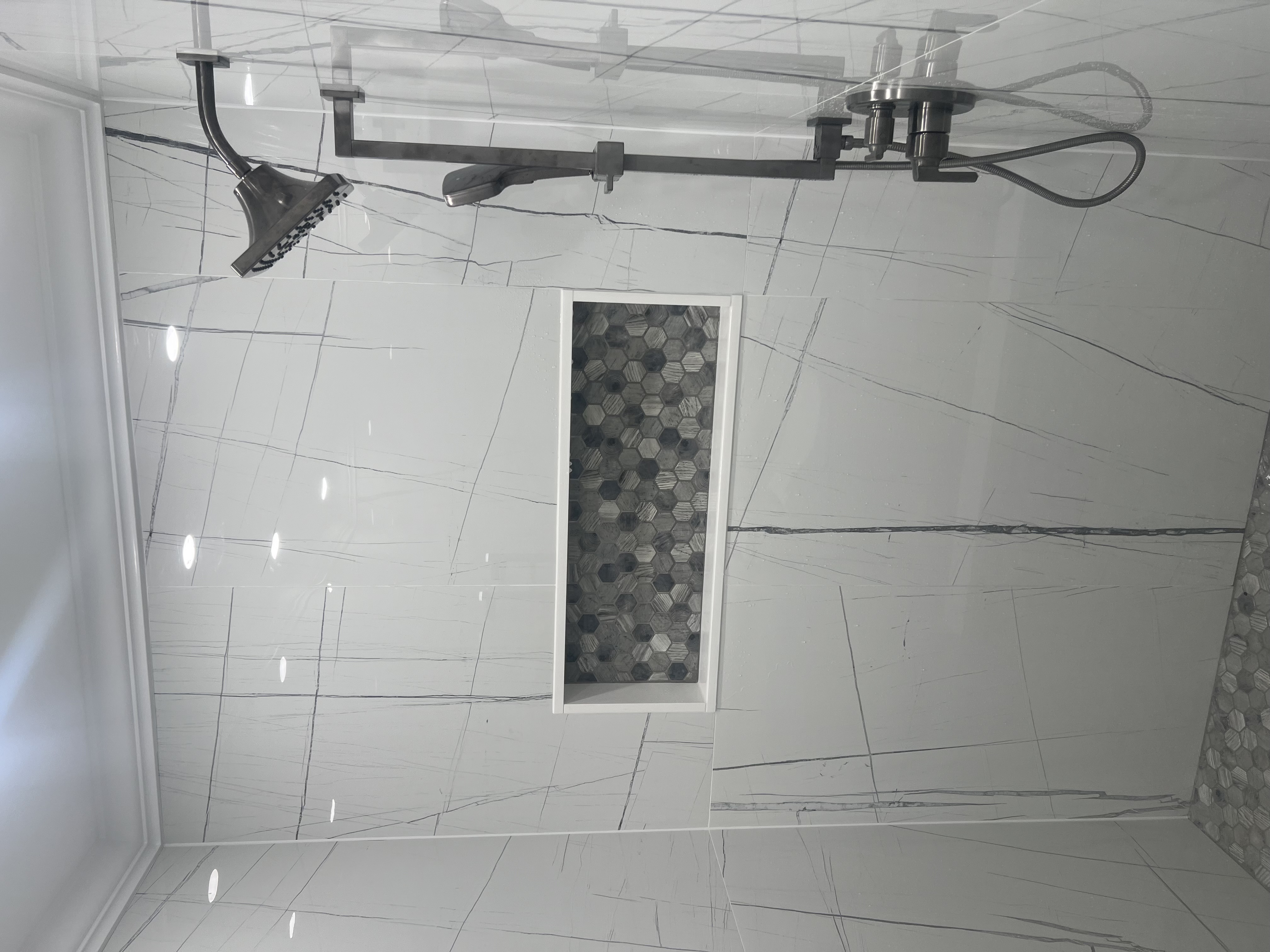
- Marble-look and natural stone-look tiles — porcelain's through-body color makes cut edges more convincing
- Full-body color means chips and edge wear are less visible
For kitchen backsplashes, ceramic offers more artisan and handmade options that create visual warmth and texture. For floors and shower walls, porcelain's large-format capabilities and through-body color offer a cleaner, more premium appearance.
Installation Differences
| Installation Factor | Ceramic | Porcelain |
|---|---|---|
| Cutting difficulty | Easy (snap cutter works) | Harder (wet saw required) |
| Weight per sq ft | Lighter | 15-20% heavier |
| Thinset requirements | Standard thinset | Modified or large-tile thinset |
| Subfloor preparation | Standard | Must be perfectly flat |
| DIY friendly | More forgiving | Less forgiving |
| Installation time | Faster | 10-15% slower |
Porcelain's density and hardness make it more demanding to install correctly. The heavier weight means subfloors must be adequately supported, especially in older NJ homes where floor joists may be undersized by modern standards. Porcelain's lower absorption rate means it does not bond as easily with standard thinset — a modified thinset with polymer additives is essential for proper adhesion.
For large-format porcelain tiles (anything over 15 inches on one side), the substrate must be perfectly flat. Any deviation in the subfloor translates to lippage — where tile edges are not flush. In older Monmouth County homes with plywood subfloors, this often requires a self-leveling underlayment before tile installation. This adds $2 to $4 per square foot but is essential for a professional result.
Room-by-Room Recommendations for NJ Homes
Kitchen Floors: Porcelain Wins
Kitchen floors take more punishment than any other surface in your home. Foot traffic, dropped pots, dragged chairs, spilled liquids, tracked-in dirt and moisture. The tile needs to handle all of it without showing wear for 15 to 20 years.
Our recommendation: Porcelain with a PEI rating of 4 or 5 (commercial-grade durability). Large-format tiles (12x24 or 24x24) in a natural stone or concrete look create a modern, seamless floor with minimal grout lines. Wood-look porcelain planks (6x36 or 8x48) deliver the warmth of hardwood with zero water damage risk.
Budget alternative: If porcelain exceeds your budget for a large kitchen floor, ceramic rated PEI 3 or higher is acceptable for moderate-traffic kitchens. But for NJ homes where the kitchen is the primary gathering space — which is most of them — porcelain is the right investment.
For more on kitchen flooring options and how they integrate with a full remodel, see our hardwood flooring guide for comparisons with other materials.
Kitchen Backsplash: Ceramic Is Often Better
Backsplashes face no foot traffic, no heavy impact, and minimal water exposure (aside from cooking splashes near the stove). This is where ceramic's strengths — variety, artisan character, and lower cost — shine.
Handmade zellige tiles, hand-painted ceramics, textured subway tiles, and decorative mosaics are overwhelmingly ceramic. These materials create the warmth, character, and visual interest that make a backsplash the focal point of a kitchen.
Our recommendation: Choose ceramic for artistic, textured, or handmade backsplash designs. Choose porcelain only if you want a large-format slab backsplash that continues seamlessly from your countertop material.
Bathroom Floors: Porcelain Wins
Bathroom floors deal with constant moisture — splashes from the shower, condensation, dripping towels, and NJ's summer humidity. The tile absorbs water from below (through grout joints) and above (from surface exposure). Porcelain's sub-0.5% absorption rate protects against both pathways.
Our recommendation: Porcelain rated for wet areas. Textured or matte finishes for slip resistance. If you are adding heated bathroom floors, porcelain conducts and retains heat better than ceramic — another advantage.
Shower Floors and Walls: Porcelain Only
There is no debate here. Shower enclosures are the most demanding wet environment in your home. Water contact is constant. Steam exposure is intense. And the consequences of tile failure are severe — water infiltration behind the tile leads to mold, structural damage, and expensive remediation.
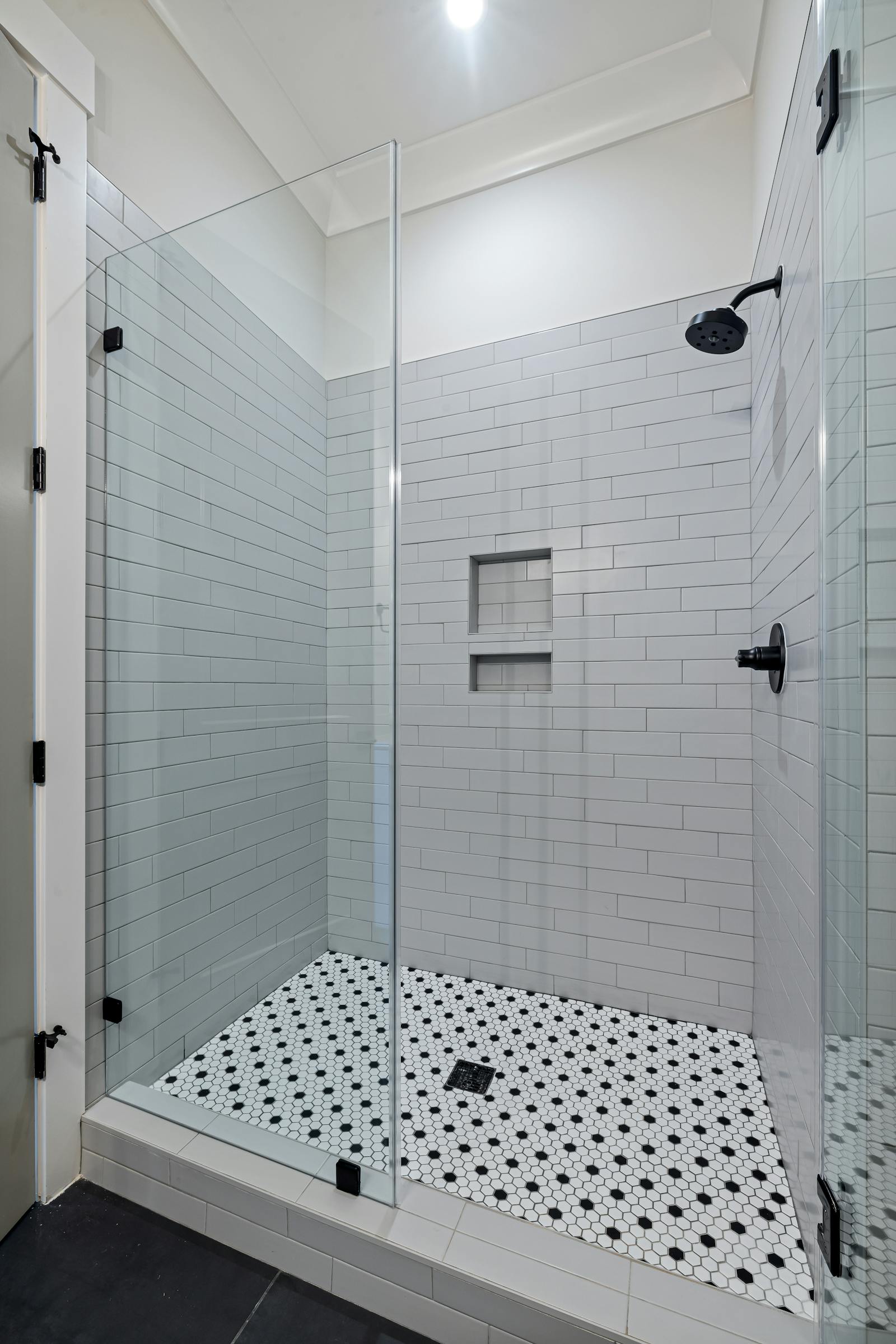
Our recommendation: Porcelain everywhere in the shower. Full stop. For shower floors specifically, choose small-format porcelain mosaic (2x2 or hexagonal) for better drainage slope and grip. For shower walls, large-format porcelain (12x24 or larger) minimizes grout lines and creates a cleaner, more spa-like appearance.
Mudrooms, Laundry Rooms, and Entryways: Porcelain Wins
These spaces deal with tracked-in moisture, dirt, road salt (in NJ winters), and temperature fluctuations near exterior doors. Porcelain handles all of these conditions without degradation. Ceramic in a NJ mudroom will absorb moisture from wet boots and road salt, leading to staining and premature wear.
Enclosed Porches and Three-Season Rooms: Porcelain Only
If the space experiences any temperature variation or moisture exposure, porcelain is the only option. Ceramic tiles in unheated NJ enclosed porches fail within 3 to 5 years from freeze-thaw cycling. The absorbed moisture freezes, expands, and cracks the tile body from the inside out.
Common Tile Selection Mistakes NJ Homeowners Make
Mistake 1: Choosing Tile Based on Appearance Alone
The tile that looks perfect in the showroom may be completely wrong for your application. A beautiful hand-glazed ceramic tile is stunning on a backsplash wall but will crack on a kitchen floor. A delicate mosaic is gorgeous in a picture but impossible to keep clean in a shower. Always match the tile type to the application first, then narrow by appearance.
Mistake 2: Using Ceramic on Shower Floors to Save Money
We have replaced more ceramic shower floors than we can count. The $300 you save on materials costs $3,000 to $5,000 to remediate when moisture infiltration causes mold and tile failure in 7 to 10 years. Shower floors are not the place to economize on tile type.
Mistake 3: Ignoring the PEI Rating
The Porcelain Enamel Institute (PEI) rates tile wear resistance on a 1 to 5 scale. PEI 1 and 2 are wall-only tiles. PEI 3 handles light residential floor traffic. PEI 4 handles all residential traffic. PEI 5 is commercial-grade. Many homeowners buy PEI 2 or 3 tiles for kitchen floors because they liked the design, then wonder why the tile shows wear after 3 years. Always check the PEI rating for floor applications.
Mistake 4: Not Accounting for NJ Climate
New Jersey's climate creates specific demands that warmer states do not face. Freeze-thaw cycles damage high-absorption tiles. Humidity promotes mold in porous tile bodies. Salt air in coastal communities corrodes certain finishes. Always factor NJ conditions into your tile decision — not just aesthetics and cost.
Mistake 5: Assuming All Porcelain Is Equal
Not all porcelain tile is created equal. The Porcelain Tile Certification Agency (PTCA) certifies tiles that meet the less-than-0.5% absorption standard. Some tiles labeled "porcelain" do not actually meet this threshold. Look for the PTCA certification mark, especially for wet-area applications. If the manufacturer cannot provide test data for water absorption, be cautious.
Smart Strategies: Mixing Ceramic and Porcelain in One Project
You do not have to choose one or the other for your entire home. The smartest approach — and the one we recommend most often — is using each tile type where it performs best.
Kitchen: Porcelain on the floor, ceramic on the backsplash. Bathroom: Porcelain on the floor and in the shower, ceramic on accent walls or wainscoting. Whole-home remodel: Porcelain in all wet and high-traffic areas, ceramic for decorative walls and low-moisture spaces.
This hybrid approach optimizes both your budget and your performance. You get the durability and moisture resistance of porcelain where it matters most, and the design variety and lower cost of ceramic where durability is less critical.
For a comprehensive look at bathroom renovation costs and material choices, see our bathroom remodel cost guide.
What We Recommend for Most NJ Homeowners
After 20 years and thousands of tile installations across Monmouth and Ocean Counties, here is our standard recommendation:
For kitchen floors: Large-format porcelain (12x24 or 24x24) in a matte or textured finish. PEI 4 or higher. Budget $12 to $25 per square foot installed.
For kitchen backsplashes: Ceramic in your preferred style — zellige, handmade, large-format, or mosaic. Budget $10 to $35 per square foot installed depending on tile choice.
For bathroom floors: Porcelain in a textured or matte finish for slip resistance. Budget $12 to $25 per square foot installed. Add radiant heat if budget allows — porcelain is the ideal conductor.
For showers: Porcelain everywhere — walls and floor. Small-format mosaic on the shower floor for drainage. Large-format on the walls for minimal grout. Budget $15 to $30 per square foot installed.
For mudrooms and laundry rooms: Porcelain in a durable, easy-to-clean finish. Wood-look porcelain planks work beautifully in these transitional spaces. Budget $12 to $20 per square foot installed.
The bottom line: Porcelain costs more upfront but performs better, lasts longer, and costs less over the life of your home — especially in NJ's demanding climate. Use ceramic strategically for decorative applications where its artisan character and lower price point make sense.
Ready to Choose the Right Tile for Your NJ Kitchen or Bathroom?
Tile selection is one of the most important decisions in a kitchen or bathroom remodel — and one of the most confusing. With hundreds of options at every price point, it is easy to make a choice that looks great in the showroom but fails in your home.
We help Monmouth and Ocean County homeowners navigate this decision every week. We will come to your home, assess your space, discuss your style preferences and budget, and recommend the specific tile type, size, and finish that will perform best for your application.
Schedule your free in-home consultation or call us at (732) 984-1043. No pressure, no obligation — just honest advice from a team that has been installing tile across New Jersey for over 20 years.
We serve all of Monmouth County including Freehold Township, Holmdel, Colts Neck, Marlboro, Manalapan, Middletown, Red Bank, and surrounding communities.
*Custom Kitchens By Lopez is a licensed NJ Home Improvement Contractor (HIC #13VH04175700) based in Freehold Township. We specialize in kitchen remodeling, bathroom remodeling, custom cabinetry, and general contracting across Monmouth County and Ocean County, NJ.*
Planning a Complete Kitchen?
See how CKL plans custom cabinetry, premium materials, and $75,000+ kitchen projects.
Ready to start your project?
Related Services
Countertop InstallationCustom Kitchen CabinetsTile InstallationHardwood Flooring
5 Rating(46+ reviews)
Ready to Plan the Complete Kitchen?
Move from product research to a complete design plan. See real CKL kitchens, the decisions that define luxury work, and the $75,000–$150,000+ planning range.
Explore Luxury KitchensCall 732.984.1043
Licensed & Insured20+ Years ExperienceLuxury kitchens from $75,000
Local Services
Kitchen Cabinets FreeholdKitchen Cabinets EdisonKitchen Cabinets ManalapanKitchen Cabinets MarlboroKitchen Remodeling FreeholdBathroom Remodeling Freehold
Popular Service Areas
Holmdel, NJColts Neck, NJRumson, NJMarlboro, NJShrewsbury, NJMiddletown, NJRed Bank, NJFreehold, NJSpring Lake, NJManalapan, NJ
Ready to start your project?
Get a free, no-obligation quote today.
5 (46+ reviews)
Category
Materials Guide# Porcelain Countertops: Pros, Cons, Cost & Vs. Quartz (2026 NJ Guide)# Soapstone Countertops: Pros, Cons, Cost & Colors (2026 NJ Guide)
More Articles
Ready to Start Your Project?
Request a private design consultation for your substantial kitchen, bath, cabinetry, or whole-home project.