
Framed cabinets have a hardwood face frame around the box opening — the traditional American build. Frameless (European-style) cabinets skip the frame for about 10-15% more usable storage and a sleeker look. A NJ contractor who installs both breaks down the construction, real NJ cost per linear foot, durability, brands, and which fits your home.
Plan Your ProjectView Our Work
Custom Kitchens by Lopez TeamJune 10, 202612 min read
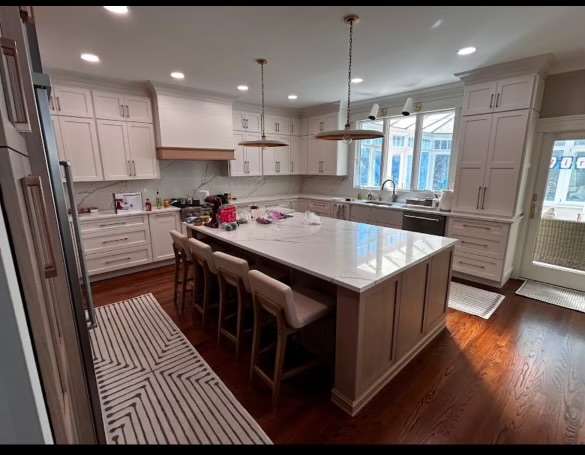
Deciding on new cabinets?
We build and install both framed and frameless cabinets in NJ
As a custom cabinet shop, we build framed boxes, frameless boxes, and full-overlay hybrids — and we install semi-custom framed brands too. We will tell you honestly which construction fits your kitchen, your storage needs, and your budget. Licensed (NJ HIC #13VH04175700), NARI member, serving Monmouth, Ocean, and Middlesex County.
Custom Kitchen CabinetsFramed or frameless, built to your kitchen's exact dimensions and style.Kitchen Remodeling Cost in NJSee where cabinets fit in a full NJ kitchen remodel budget.
Get a Free QuoteCall 732.984.1043
Framed vs Frameless Cabinets: Which Is Right for Your NJ Kitchen? (2026)
Quick answer: The difference is the box. Framed cabinets have a hardwood face frame (about 1.5 inches wide) attached to the front of the cabinet box — the doors and hinges mount to that frame. Frameless cabinets (European-style or "full-access") skip the frame entirely: doors mount directly to thicker box sides, giving you roughly 10-15% more usable storage and a sleeker, seamless look. In NJ, semi-custom framed cabinets run about $150-$500 per linear foot installed; comparable frameless lines run about $200-$600. Framed is the safer fit for traditional and coastal NJ homes; frameless wins for modern kitchens and maximum storage.
Most homeowners walk into a showroom thinking about door styles and paint colors. Almost nobody walks in thinking about how the cabinet box itself is built — and yet that decision shapes your storage, your budget, which brands you can even order from, and how your kitchen will look for the next 25 years.
After 20+ years building and installing cabinets across Monmouth, Ocean, and Middlesex County, we have put framed boxes into 1920s colonials in Freehold and frameless full-access kitchens into new construction in Marlboro. This is the comparison we walk clients through at the design table — the real construction differences, real NJ pricing, and an honest verdict for each type of home.
What you will learn:
- How framed and frameless construction actually differ (with the anatomy of each box)
- How much more storage frameless really gives you — with numbers
- NJ cost per linear foot installed for both, by quality tier
- Which construction fits shore homes, colonials, and modern NJ builds
- The full-overlay hybrid that splits the difference
- Which brands build framed, which build frameless, and who builds both
Quick Comparison: Framed vs Frameless at a Glance
| Feature | Framed | Frameless | Winner |
|---|---|---|---|
| Construction | Hardwood face frame on box front | No frame; thicker box panels | Depends on priority |
| Look | Traditional to transitional | Sleek, modern, seamless | Depends on taste |
| Usable storage | Frame narrows each opening | Full-access interior, ~10-15% more | Frameless |
| Drawer width | Loses 1-2" per opening to the frame | Nearly full box width | Frameless |
| NJ cost (semi-custom, per LF installed) | $150-$500 | $200-$600 | Framed (cheaper) |
| Door style options | Inset, partial overlay, full overlay | Full overlay only | Framed |
| Brand availability in NJ | Widest (most American brands) | Growing but narrower | Framed |
| Durability | Excellent (frame adds rigidity) | Excellent (when 5/8-3/4" panels) | Tie |
| Best for | Colonials, coastal, traditional NJ homes | Modern kitchens, small kitchens, max storage | Depends on home |
Bottom line: if your home and taste lean traditional or coastal, framed gives you more style and brand options at a lower price. If you want a modern kitchen or need every cubic inch of storage, frameless is worth the premium. And if you want the frameless look without leaving framed brands, full-overlay doors get you 90% of the way there.
What Are Framed Cabinets? (The American Standard)
Framed construction is how American cabinets have been built for over a century. Picture the box, then a flat hardwood frame — like a picture frame — glued and fastened across its front edge:
- The box — sides, top, bottom, and back, typically 1/2-inch plywood or furniture board in semi-custom lines
- The face frame — solid hardwood rails (horizontal) and stiles (vertical), usually about 1.5 inches wide, attached to the front of the box
- The doors — hung on hinges that mount to the face frame, not the box
- The center stile — on many double-door cabinets, a vertical frame piece runs down the middle between the doors
The face frame does real work. It squares the box, stiffens the front, gives the hinges solid hardwood to bite into, and provides a forgiving surface for scribing cabinets tight to wavy walls — which, in older Monmouth County colonials, is not a hypothetical.
The three framed door styles
How the doors sit on that frame defines the look — and this is where the "full overlay vs frameless" confusion starts:
- Inset — doors sit flush *inside* the frame opening, furniture-style. The most expensive, most traditional look; common in high-end historic renovations.
- Partial (standard) overlay — doors cover part of the frame, leaving visible frame borders between doors. The builder-grade look of the 1980s-2000s.
- Full overlay — doors sized to cover almost the entire frame. From the outside it mimics frameless; behind the doors, the frame is still there.
For more on the door *style* decision itself — shaker fronts vs slab fronts — see our shaker vs flat panel cabinets guide.
What Are Frameless Cabinets? (European / Full-Access)
Frameless construction came out of post-war European manufacturing and is the standard across most of the world. There is no face frame at all:
- The box is the structure — sides, top, and bottom in thicker 5/8- to 3/4-inch panels, because the box alone provides the rigidity a frame would add
- Doors mount directly to the box sides — with fully concealed cup hinges
- Full overlay only — doors and drawer fronts cover the entire box face, leaving 2-3mm reveals between them
- No center stile — open a double-door frameless cabinet and the full width is clear
The interior is the selling point. Cabinet makers call frameless "full-access" construction for a reason: every inch of the opening is usable, drawers run wider, and roll-outs slide without catching a frame lip.
The trade-off is precision. Frameless boxes have no frame to square them or scribe against, so they demand flatter walls, more careful leveling, and an installer who works to tighter tolerances. It is less forgiving of the out-of-plumb framing we routinely find in older NJ housing stock.
Storage: How Much More Space Does Frameless Actually Give You?
This is the most concrete difference, so here are the numbers we see at the design table:
- Each framed opening loses about 1.5 inches on every framed edge to the face frame — and double-door cabinets often lose another 2-3 inches to the center stile.
- Drawers gain 1-2 inches of width per opening in frameless construction, because the drawer box only has to clear the cabinet sides, not a frame.
- Across a full kitchen, frameless yields roughly 10-15% more usable interior volume — in a typical 20-linear-foot NJ kitchen, that is about one extra cabinet's worth of storage without adding a single box.
- Roll-out trays and organizers fit wider and pull cleaner, since there is no frame lip to clear.
In small kitchens — shore bungalows, condos, galley kitchens in older two-families — that 10-15% is often the difference between a kitchen that works and one that always feels short a cabinet. It is also why frameless dominates in European apartments and why we usually spec it for compact NJ layouts.
Framed vs Frameless Cabinet Cost in NJ (2026)
Construction type matters less to price than quality tier — but at the same tier, frameless usually carries a 10-20% premium. Here is what NJ homeowners actually pay, installed:
| Tier | Framed (per LF installed) | Frameless (per LF installed) |
|---|---|---|
| Stock / big-box | $75-$200 | Rare (IKEA: ~$100-$250 cabinets + install) |
| Semi-custom | $150-$500 | $200-$600 |
| Custom shop | $500-$1,500+ | $500-$1,500+ |
Why frameless costs more at the semi-custom tier:
- More material — every panel is 5/8-3/4 inch, not just the face frame
- Edge banding on every exposed panel edge instead of a hardwood frame
- Tighter manufacturing and installation tolerances — 2-3mm reveals show every error
- Hardware — full-extension undermount slides and premium concealed hinges are the norm, not an upgrade
For national context, HomeAdvisor's kitchen cost data shows the same pattern we see locally: cabinets are the single biggest line item in a kitchen remodel, commonly a third or more of the total budget. To see where cabinets sit inside a full project number, see our kitchen remodeling cost guide for NJ. Keeping a workable footprint can reduce labor and utility-relocation costs with either cabinet construction.
For the deeper stock vs semi-custom vs custom price breakdown, we wrote a full tier-by-tier guide.
Which NJ Homes Favor Which Construction?
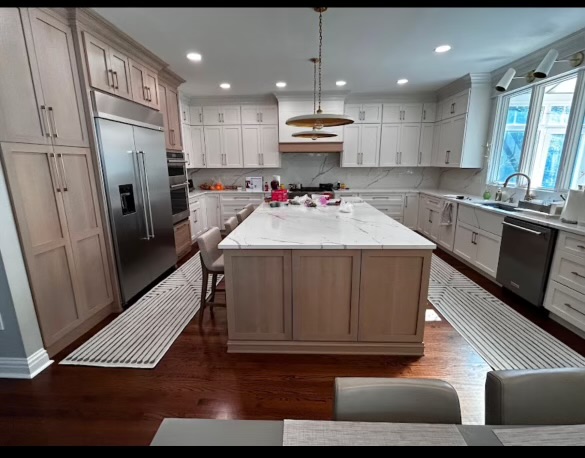
After two decades of installs across Monmouth and Ocean County, the pattern is consistent:
- Shore homes (Toms River, Barnegat, LBI-area) — coastal style runs classic: white or light shaker fronts, beadboard accents. Framed full-overlay is the natural fit, and the face frame's scribe-friendliness helps in older shore construction. Modern beach rebuilds, though, increasingly go frameless slab.
- Colonials and older homes (Freehold, Colts Neck, Middletown) — framed, full stop. Inset framed if the budget allows and the home is historic; full-overlay framed for everyone else. Frameless looks out of place against six-panel doors and crown molding, and old-house walls punish its tolerances.
- New construction and modern remodels (Marlboro, Manalapan, Edison) — frameless slab or frameless with shaker-profile doors. Clean reveals, integrated appliances, push-to-open hardware.
- Small kitchens anywhere — frameless, for the storage math alone.
The national data backs up what we see locally: in Houzz's research on renovating homeowners, 61% choose shaker doors versus 21% flat-panel — but the 2025 U.S. Houzz Kitchen Trends Study puts transitional style at #1 (25%) with modern (12%) and contemporary (11%) holding steady — which is exactly the blend a full-overlay framed or shaker-front frameless kitchen delivers.
The Hybrid Option: Full-Overlay Framed (and Shaker-Front Frameless)
Most NJ kitchens we build land in the middle, and there are two ways to get there:
- Full-overlay framed — framed construction, doors sized to hide the frame. You keep the huge framed brand catalog, the lower price, and the forgiving install, and from the outside it reads as a sleek modern kitchen. This is the most common choice in our Monmouth County projects.
- Shaker-front frameless — frameless boxes with a five-piece shaker door. You get full-access storage *and* a transitional face that does not fight a traditional home. More European semi-custom and custom shops offer this every year.
Neither is a compromise — they are the two best answers to "I want it to look current but not cold." Which one wins usually comes down to budget (framed full-overlay is cheaper) versus storage (frameless wins).
Brand Availability: Who Builds What
Construction type quietly decides which brands you can even shop. The honest map:
Framed (traditional American lines):
- KraftMaid — framed, solid wood face frames, semi-custom
- Merillat — framed, solid wood face frames (see our KraftMaid vs Merillat comparison for the head-to-head)
- Fabuwood — framed lines, manufactured in Newark, NJ — short lead times for NJ projects
- Wolf, Yorktowne, Waypoint — framed semi-custom staples in NJ showrooms
Frameless (European / full-access):
- IKEA (SEKTION) — frameless, the budget entry point
- UltraCraft — American-made, frameless-only semi-custom
- Fabuwood Illume — the frameless line from the Newark factory
- SieMatic, Poggenpohl, Scavolini — the European luxury tier
- Custom shops (like ours) — we build framed, frameless, and inset boxes to order, so the construction follows the design instead of the catalog
If you are comparing semi-custom brands for a quote, start with the construction question first — it cuts the brand list in half before you ever argue door styles.
Durability: Is One Construction Stronger?
The short answer: a quality cabinet is a quality cabinet, in either construction. Both framed and frameless boxes are certified under the same ANSI/KCMA A161.1 industry standard — the structural, drawer-cycle, and finish tests do not care whether there is a face frame.
What actually determines whether cabinets survive 25 years of NJ kitchens:
- Box material — 1/2-3/4 inch plywood survives humidity and sink leaks; particleboard swells. This matters more at the shore, where salt air and summer humidity work on everything.
- Hinges and slides — the moving parts fail long before the boxes do. Soft-close cup hinges and undermount slides are worth it in both constructions.
- Frame vs panel rigidity — a hardwood face frame stiffens a framed box; frameless compensates with thicker panels and a full back. Built right, the rigidity is equivalent. Built cheap, both sag.
- Installation — frameless punishes sloppy leveling; framed hides it. With a good installer, this difference disappears.
One durability myth worth killing: frameless cabinets are not "flimsy European boxes." A 3/4-inch plywood frameless box from a good shop is structurally on par with anything framed — it simply achieves the stiffness differently.
Cabinet Condition, Resale, and Long-Term Value
Two practical end-of-life notes before the verdict:
- Both constructions can be replaced within an existing footprint. The important questions are whether the layout works, storage is adequate, appliances fit, and the new cabinet system can be installed cleanly.
- Resale follows condition and style, not construction. Buyers see doors, not boxes. Per Remodeling Magazine's Cost vs Value data, a minor kitchen remodel — new fronts, counters, and hardware on existing layouts — recoups roughly 96% of its cost at resale nationally, one of the best returns of any home project. Whether the boxes behind those new fronts are framed or frameless does not change the appraisal.
The Verdict: Framed or Frameless for Your NJ Kitchen?
Choose framed if:
- Your home is a colonial, cape, or traditional shore house where inset or full-overlay framed simply belongs
- You want the widest brand selection and the lowest semi-custom pricing
- Your walls and floors are old-house crooked — the face frame forgives what frameless will not
- You love the inset, furniture-look door style (framed-only, by definition)
Choose frameless if:
- You want a modern or European kitchen with slab fronts and clean reveals
- Your kitchen is small and every cubic inch of storage counts — the 10-15% gain is real
- You want the widest possible drawers and full-access roll-outs
- You are doing new construction or a gut remodel where walls will be flat and plumb
Either way: decide the construction first, the brand second, and the door style third. It is the order that keeps you from falling in love with a door that does not exist on the construction you need.
If you want a second opinion on a quote you have in hand — or you want custom cabinets built to your kitchen instead of ordered from a catalog — that conversation is free.
FAQ: Framed vs Frameless Cabinet Questions Answered
What is the difference between framed and frameless cabinets?
Framed cabinets have a hardwood face frame — typically about 1.5 inches wide — attached to the front of the cabinet box, and the doors and hinges mount to that frame. Frameless cabinets (also called European-style or full-access) have no face frame: the doors mount directly to the sides of a thicker box, so the entire interior opening is usable. Framed is the traditional American construction; frameless is the European standard that now shows up in most modern NJ kitchens.
Are frameless cabinets more expensive than framed?
Usually, yes — at the same quality tier, frameless typically costs about 10-20% more. In NJ, semi-custom framed cabinets run roughly $150-$500 per linear foot installed, while comparable frameless lines run about $200-$600. The premium comes from thicker box material on every panel, edge banding, and tighter installation tolerances. The exception is IKEA, which is frameless and budget-priced. At the full-custom tier ($500-$1,500+ per linear foot), construction type barely moves the price.
Do frameless cabinets really have more storage space?
Yes. Because there is no face frame narrowing each opening, you gain roughly 10-15% more usable interior space across a kitchen. Drawers can be built 1-2 inches wider per opening, roll-out trays slide out without catching a frame lip, and there is no center stile blocking the middle of double-door cabinets. In a typical 20-linear-foot NJ kitchen, that adds up to about an extra cabinet's worth of storage.
Are frameless cabinets less durable than framed cabinets?
Not when they are built properly. A quality frameless cabinet uses 5/8- to 3/4-inch panels on every side, which makes the box itself as rigid as a framed box gets from its hardwood frame. Both constructions are tested to the same ANSI/KCMA A161.1 industry standard. What actually determines lifespan is box material, hinge quality, and moisture resistance — which matters in humid NJ kitchens and shore homes — not whether there is a face frame.
What is the difference between full overlay and frameless?
Full overlay is a door style on a framed cabinet: the doors are sized to cover almost the entire face frame, so from the outside it looks nearly identical to frameless. But the frame is still there behind the doors, so you keep the narrower openings and the center stile. Frameless construction has no frame at all — you get the seamless look and the full-access interior. Full-overlay framed is the popular middle ground for NJ homeowners who want the modern look from framed brands.
Are KraftMaid and Merillat cabinets framed or frameless?
Both KraftMaid and Merillat build framed cabinets with solid wood face frames — the traditional American construction. If you want the framed-brand ecosystem with a modern look, order full-overlay door styles. For true frameless, you would look at IKEA, UltraCraft, Fabuwood's Illume line, European brands like SieMatic or Scavolini, or a custom shop that builds frameless boxes.
Can frameless cabinets be replaced without changing the layout?
Yes. Replacement frameless cabinets can usually use the existing footprint when the layout, appliance clearances, and storage plan still work. The new cabinets should be measured and planned as a complete system rather than treated as a door-only update.
Which is better for resale value in NJ — framed or frameless?
Neither construction type itself moves resale value much — buyers react to the door style, finish quality, and layout, not what is behind the doors. Shaker doors (which can go on either construction) still have the broadest NJ buyer appeal, while sleek frameless kitchens photograph well in modern listings. A minor kitchen remodel recoups roughly 96% of its cost at resale nationally, so the smarter resale play is quality and condition, not framed vs frameless.
Framed or Frameless in NJ — How We Build Them
This is one of the few cabinet questions where being a custom shop changes the answer: we are not locked to one construction, so the construction gets chosen for the kitchen instead of the kitchen bending to a catalog. Framed full-overlay for the Freehold colonial, frameless full-access for the Marlboro new-build, inset for the historic renovation — built, finished, and installed by the same crew.
If you are weighing framed against frameless for a kitchen anywhere in Monmouth, Ocean, or Middlesex County, bring us the layout. We are licensed (NJ HIC #13VH04175700), NARI members, led by owner Enrique Lopez — and we will give you the same honest math you just read, applied to your actual kitchen. Call 732.984.1043 or request a free quote.
Planning a Complete Kitchen?
See how CKL plans custom cabinetry, premium materials, and $75,000+ kitchen projects.
Ready to start your project?
Related Services
Countertop InstallationCustom Kitchen CabinetsTile InstallationHardwood Flooring
5 Rating(46+ reviews)
Ready to Plan the Complete Kitchen?
Move from product research to a complete design plan. See real CKL kitchens, the decisions that define luxury work, and the $75,000–$150,000+ planning range.
Explore Luxury KitchensCall 732.984.1043
Licensed & Insured20+ Years ExperienceLuxury kitchens from $75,000
Local Services
Kitchen Cabinets FreeholdKitchen Cabinets EdisonKitchen Cabinets ManalapanKitchen Cabinets MarlboroKitchen Remodeling FreeholdBathroom Remodeling Freehold
Popular Service Areas
Holmdel, NJColts Neck, NJRumson, NJMarlboro, NJShrewsbury, NJMiddletown, NJRed Bank, NJFreehold, NJSpring Lake, NJManalapan, NJ
Ready to start your project?
Get a free, no-obligation quote today.
5 (46+ reviews)
Category
Materials Guide# Soapstone Countertops: Pros, Cons, Cost & Colors (2026 NJ Guide)# Waterfall Countertops: Cost, Best Materials & Whether It's Worth It (NJ Guide)
More Articles
Ready to Start Your Project?
Request a private design consultation for your substantial kitchen, bath, cabinetry, or whole-home project.