
What a waterfall countertop really costs in NJ — including the waterfall-edge price premium ($1,000–$4,500), the best materials, how the mitered edge is made, the honest pros and cons, and whether it's dated. From a 20-year Monmouth County remodeler.
Plan Your ProjectView Our Work
Custom Kitchens by Lopez TeamMay 31, 202613 min read
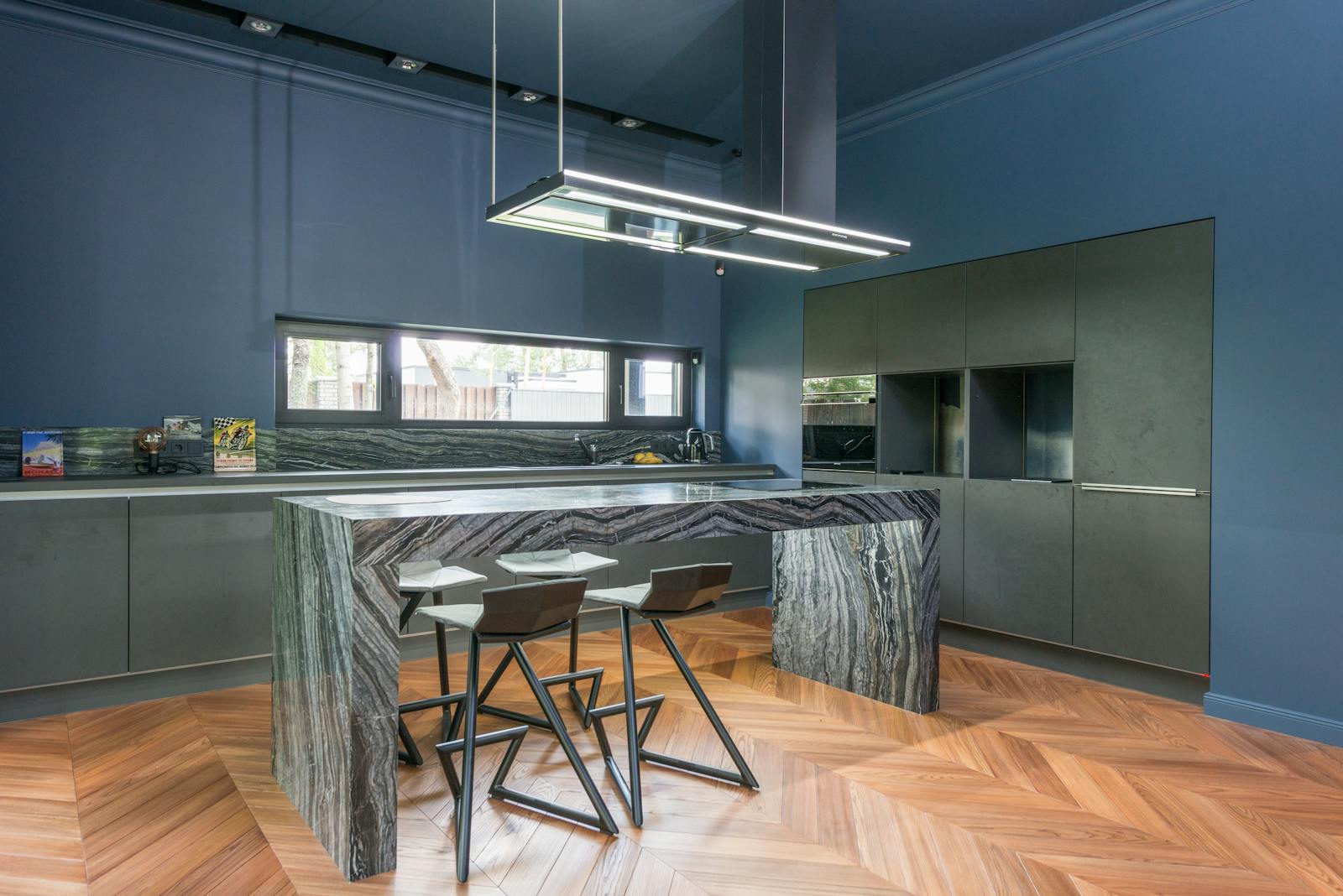
Thinking about a waterfall island?
We fabricate and install waterfall countertops across NJ
Custom Kitchens by Lopez has designed, fabricated, and installed waterfall islands and vanities throughout Monmouth, Ocean, and Middlesex County for 20+ years — with the grain-matched, chip-resistant mitered seams that make or break the look. NJ HIC #13VH04175700, NARI member.
Kitchen RemodelingPlan a full kitchen remodel with a waterfall island as the centerpiece.Quartz CountertopsQuartz is the top material for a seamless, chip-resistant waterfall edge.Countertop InstallationExpert fabrication and installation — mitered seams done right.Custom CabinetryBuild the island that carries the waterfall slab.
Get a Free QuoteCall 732.984.1043
Waterfall Countertops: Cost, Best Materials & Whether It's Worth It (NJ Guide)
Quick answer: A waterfall countertop is one where the slab continues vertically down the side (or both sides) of an island or cabinet to the floor, instead of stopping at the edge — creating a seamless, sculptural "cascade." It costs more than a standard countertop because it needs extra material plus a precise mitered seam. In NJ, budget roughly $1,000–$2,500 extra for a single-side waterfall and $2,000–$4,500 extra for a double, on top of your standard countertop cost.
A waterfall island is one of the most-requested features we install on high-end kitchens — and one of the most misunderstood when it comes to cost. After 20+ years fabricating and installing countertops across Monmouth and Ocean County, here is the honest, contractor's-eye guide: what a waterfall countertop actually costs in New Jersey, how it's built, the best materials for it, the real downsides, and whether it's worth it.
What is a waterfall countertop?
A waterfall countertop is a countertop where the surface "falls" off the edge and continues straight down the side of the island or cabinet all the way to the floor. Instead of a standard countertop that overhangs a finished cabinet side, the same slab wraps a crisp 90-degree corner and becomes the side panel — so the stone looks like it's cascading over the edge.
It's most common on kitchen islands, but you'll also see it on peninsulas, bar tops, fireplace surrounds, and bathroom vanities.
Waterfall edge vs. a standard countertop edge
| Standard edge | Waterfall edge | |
|---|---|---|
| Where the slab stops | Overhangs the cabinet, finished edge | Continues down the side to the floor |
| Cabinet side | Visible (wood, panel, paint) | Covered by the stone slab |
| Material used | Counter surface only | Counter surface + side panel(s) |
| Look | Traditional / transitional | Modern, seamless, sculptural |
| Cost | Baseline | Baseline + the waterfall premium |
One-side vs. two-side (double) waterfall
A single waterfall cascades down one end of the island — usually the end you see first when you walk in. A double waterfall cascades down both ends, wrapping the island into a fully finished, furniture-like block of stone. A double looks more dramatic and symmetrical, but it uses more material and more mitered seams, so it costs roughly twice the edge premium.
How much does a waterfall countertop cost in NJ? (2026)
This is the question every other guide dances around with "it's more expensive." Here are real numbers.
The waterfall edge is a premium on top of your standard countertop cost — it's not a separate price. That premium comes from three things: the extra slab material for the side panel(s), the precise mitered fabrication, and the extra install labor for the heavy panels.
The waterfall-edge premium, broken down
| Component | What drives it | NJ figure |
|---|---|---|
| Extra slab (per side panel) | ~6–9 extra sq ft per side, at your material's installed rate | $500–$1,400 per side |
| Mitered-edge fabrication | 45-degree CNC miter, grain match, extra polishing | $300–$700 per corner (~$60–$90 per linear foot) |
| Extra install labor | Heavier panels, precise seam setting | $200–$500 per side |
| Single (one-side) waterfall — total added | ~$1,000–$2,500 | |
| Double (two-side) waterfall — total added | ~$2,000–$4,500 |
What a full waterfall island costs all-in
Add the premium above to your standard countertop surface, and most of our waterfall islands land between $3,500 and $9,000 all-in for the countertop — depending on the material, the island size, and single vs. double. The biggest swing factor is the material, which is where the per-square-foot pricing matters.
For the underlying material pricing, see our full guides on quartz countertop cost in NJ and granite countertop pricing by grade. Because a waterfall is an island feature, our full kitchen island cost breakdown is also worth a read for the rest of the island budget.
Why it costs more than a standard edge
A standard island uses the slab for the top only. A waterfall uses the slab for the top and one or two full-height side panels — that's significantly more stone. Then each corner has to be cut at a perfect 45-degree miter and joined so the seam nearly disappears, which is skilled, slow fabrication. Heavier panels also mean more careful handling and a bigger install crew. More material plus more labor equals the premium.
How a waterfall countertop is made: the mitered edge
The thing that separates a beautiful waterfall from a clumsy one is the mitered seam, and it's worth understanding before you hire anyone.
The 45-degree mitered seam, explained
To turn the corner without an ugly butt-joint, the fabricator cuts the end of the top slab and the top of the side slab each at a 45-degree angle, then glues them together so they meet at a crisp 90-degree corner. Done well, the seam is a hairline you have to look for. Done poorly, you get a visible dark line, a lippage you can feel, or a chip-prone edge.
Grain and vein matching (book-matching)
On any veined material — quartzite, marble, veined quartz — a good fabricator book-matches the slabs so the veining flows continuously around the corner, like the stone never stopped. This is why a waterfall job buys extra slab: you can't just use a leftover offcut; the side panel has to come from the right part of the slab to keep the pattern lined up.
Why not every fabricator will do it
Mitered waterfalls are slower, riskier, and require a CNC saw and real experience. Plenty of shops avoid them or charge a steep premium because a botched miter wastes an expensive slab. This is the #1 reason to use a fabricator who installs waterfalls regularly — not one doing their first.
Best materials for a waterfall countertop
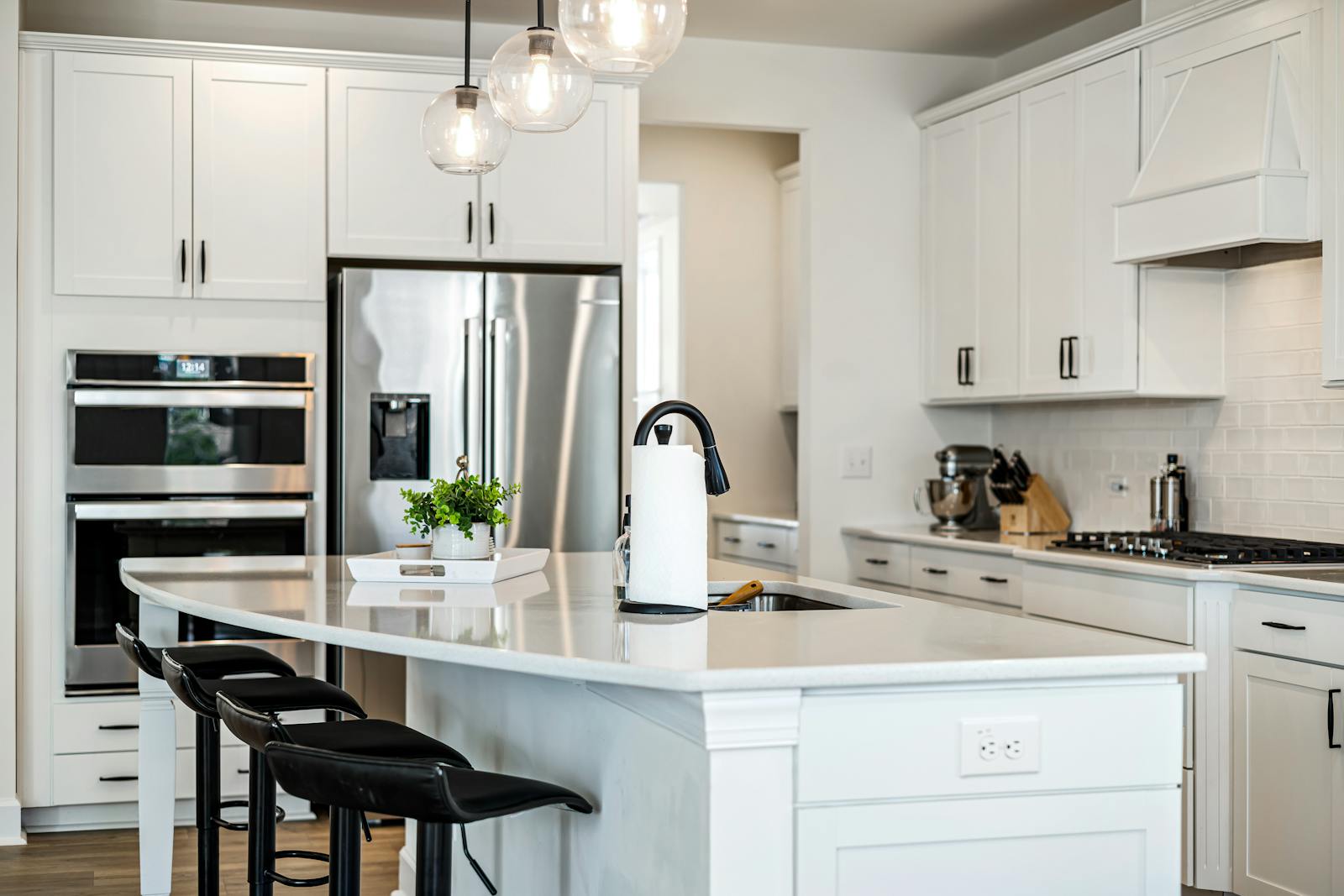
Not every countertop material is a good waterfall candidate. The two make-or-break factors are how seamlessly the veining matches across the miter and how well the edge resists chipping.
| Material | Waterfall fit | Notes |
|---|---|---|
| Quartz | Best | Consistent, predictable pattern matches seamlessly; durable and chip-resistant. The safest choice. |
| Porcelain / sintered stone | Best | Thin, ultra-durable, great for big book-matched panels. |
| Quartzite | Good (with caution) | Stunning natural veining, but harder to match and more chip-prone — needs a top fabricator. |
| Granite | Good (with caution) | Works well in consistent patterns; busy granites are harder to match across the corner. |
| Marble | Use with care | Gorgeous, but soft and stain-prone; best for low-use or formal spaces. |
| Butcher block / wood | Niche | A warm, budget waterfall look, but not a true seamless-stone effect. |
Our recommendation for most NJ kitchens: quartz. It gives you the cleanest seamless match and the toughest edge. If you love natural stone, quartzite is the standout — see our quartz vs. quartzite comparison, and if you're weighing all three, our granite vs. quartz vs. quartzite breakdown lays it out. For natural-stone color options, browse the popular granite colors. We install all of these — see our quartz countertop installation services.
Pros and cons of waterfall countertops
Pros
- A true focal point — a waterfall island anchors an open-plan kitchen and reads as high-end design.
- Protects the cabinet ends from scuffs, kicks, and water — the stone takes the abuse.
- Seamless, modern look that photographs beautifully and appeals to design-forward buyers.
- Durable in the right material (quartz/porcelain) — built to last decades.
Cons
- Higher cost — the $1,000–$4,500 premium above.
- The mitered corner can chip if struck hard; it's the most delicate point.
- A floor gap collects crumbs and dust where the panel meets the floor (more on this below).
- You lose that side of the island for storage, outlets, or seating overhang.
- Best for modern/transitional kitchens — it can look out of place in a traditional design.
Maintenance: chipping, cleaning, and the floor gap
Two honest realities the glossy brand pages skip:
The floor gap. Because the slab runs to the floor, there's a seam where the panel meets your flooring. Crumbs, dust, and the occasional dropped pea find their way into that line, and you'll be wiping or vacuuming it. A tight install with a clean reveal (or a small matching base detail) minimizes it, but it never fully disappears.
Chipping at the miter. The 45-degree corner is the most vulnerable spot on the whole countertop. A dropped cast-iron pan or a slammed bar stool can chip it. Quartz and porcelain shrug most of this off; softer natural stone is more at risk. Day to day, you clean a waterfall exactly like the rest of the counter — mild soap and water for quartz; for natural stone, follow the sealing schedule in your material's care guide.
Is a waterfall countertop dated? Is it worth it?
Is it dated? No. This is the top anxiety we hear, and the honest answer from designers and remodelers alike is that the clean mitered waterfall is a lasting modern look, not a fleeting trend. It has been popular for well over a decade and reads as intentional, architectural design — not a fad finish. The way to make it *look* dated is to pair it with an already-dated material or color, not the waterfall itself.
Will it help or hurt resale?
In the right home, it helps. Kitchen islands return roughly 60–80% of their cost at resale, and a waterfall is a premium upgrade that design-conscious buyers in NJ's $450K+ homes notice and remember. In a traditional starter home it can feel mismatched, so match the feature to the house. For most mid-to-high-end Monmouth and Ocean County kitchens, it's a worthwhile, lasting upgrade.
What's the trendiest countertop right now?
Quartz is still the most-chosen countertop material — around 78% of homeowners pick it — with quartzite the fast-rising second. Both are ideal surfaces for a waterfall edge, which is part of why waterfalls remain so popular. For the full picture of what's in for 2026, see our 2026 kitchen countertop trends guide.
Waterfall edges beyond the kitchen: bathroom vanities and more
The same mitered technique works beautifully on a bathroom vanity, giving a floating or freestanding vanity the same seamless, sculptural look as a kitchen island. We also use waterfall edges on bar tops, dining ledges, and fireplace surrounds. Anywhere a slab meets a visible vertical side, a waterfall turns it into a feature.
Waterfall countertop ideas and design tips
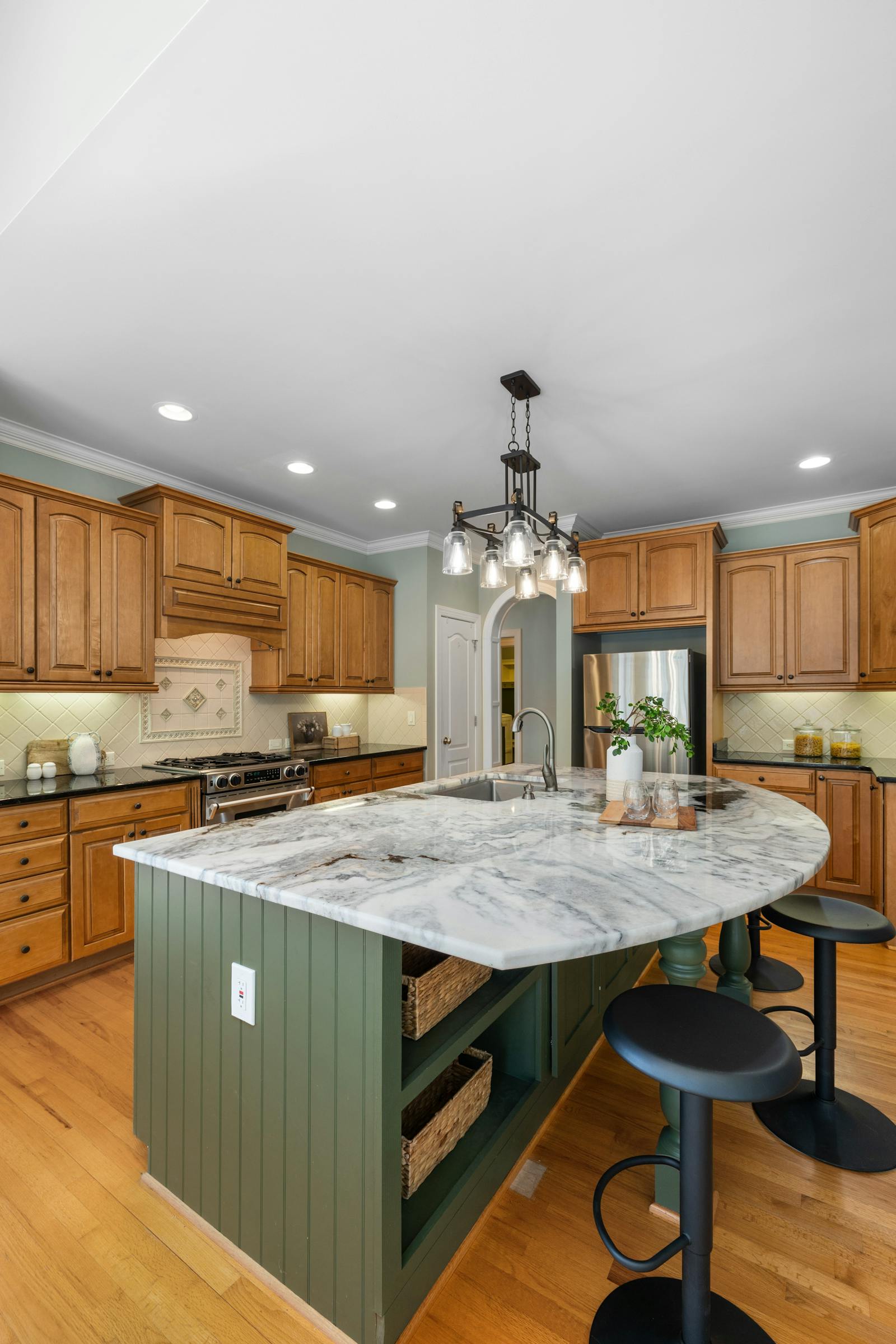
- Keep seating on the non-waterfall side — plan a 12–18 inch overhang there for stools (10 inches for occasional seating), since the waterfall side has no overhang.
- Book-match a dramatic stone (a bold quartzite or veined quartz) so the veining flows around the corner — it's the whole point of the feature.
- Go double waterfall on a freestanding island you see from all sides; single is fine when one end sits against cabinets or a wall.
- Match or contrast — a waterfall in the same stone as your perimeter counters feels cohesive; a contrasting island stone makes the waterfall pop.
- Mind the outlets — power can't go on the waterfall side, so plan pop-up or under-counter outlets. Browse more kitchen island design ideas for layouts that work.
Waterfall countertops in NJ — how we build them
A waterfall lives or dies on the fabrication: the miter, the vein match, and a dead-level install. Those are exactly the details that separate a $9,000 showpiece from a chipped seam with a crooked line.
If you're considering a waterfall island or vanity anywhere in Monmouth, Ocean, or Middlesex County, that's work we've done for 20+ years — fabricating and installing grain-matched, chip-resistant waterfalls in quartz, quartzite, and granite. We're licensed (NJ HIC #13VH04175700), NARI members, and led by owner Enrique Lopez. Call 732.984.1043 for a real quote, and we'll tell you honestly which material and edge make sense for your kitchen and budget.
Planning a Complete Kitchen?
See how CKL plans custom cabinetry, premium materials, and $75,000+ kitchen projects.
Ready to start your project?
Related Services
Countertop InstallationCustom Kitchen CabinetsTile InstallationHardwood Flooring
5 Rating(46+ reviews)
Ready to Plan the Complete Kitchen?
Move from product research to a complete design plan. See real CKL kitchens, the decisions that define luxury work, and the $75,000–$150,000+ planning range.
Explore Luxury KitchensCall 732.984.1043
Licensed & Insured20+ Years ExperienceLuxury kitchens from $75,000
Local Services
Kitchen Cabinets FreeholdKitchen Cabinets EdisonKitchen Cabinets ManalapanKitchen Cabinets MarlboroKitchen Remodeling FreeholdBathroom Remodeling Freehold
Popular Service Areas
Holmdel, NJColts Neck, NJRumson, NJMarlboro, NJShrewsbury, NJMiddletown, NJRed Bank, NJFreehold, NJSpring Lake, NJManalapan, NJ
Ready to start your project?
Get a free, no-obligation quote today.
5 (46+ reviews)
Category
Materials Guide# Porcelain Countertops: Pros, Cons, Cost & Vs. Quartz (2026 NJ Guide)# Soapstone Countertops: Pros, Cons, Cost & Colors (2026 NJ Guide)
More Articles
Ready to Start Your Project?
Request a private design consultation for your substantial kitchen, bath, cabinetry, or whole-home project.